A lot of people talk about what AI is and what AI could become. There are endless articles about chatbots, deepfakes, job displacement, and the singularity. But for me, the real value of AI is something far more mundane and far more useful.
If you've ever had a wandering curiosity that couldn't be answered by a quick Google search, AI is now the tool that can take you from question to answer in a way that simply wasn't possible before.
The question
With the recent spike in gold prices (and subsequent crash), a thought ran through my head the other day: I wonder how gold performs against commercial property over the long run?
Not a revolutionary question. The kind of thing you might mull over on a Sunday morning with a coffee. But it's also not the kind of question Google can answer easily. You'd need historical data for both asset classes, you'd need to normalise them to a common base, and you'd need to build charts that let you actually compare them. That's a research project for an intern, or at least, it used to be.
The work
To put this in context: I have never written a single line of code. Not one. I don't have a background in data science, programming, or anything close to it.
But I sat down with my morning coffee, I opened up my phone, opened up Claude (which is currently my preferred AI) and got to work. I had a conversation with it about what I was trying to achieve, and together we wrote a Python script that pulls historical gold prices and the US Federal Reserve's commercial property price index, aligns them, indexes both to a 1995 baseline, and produces charts.
How long did it take? About 30 minutes. Maybe less.
I ran the script in Terminal on my Mac. For those of you old enough to remember, Terminal looks and feels a bit like DOS from the pre-Windows era. You type a command, hit enter, and things happen. I had no idea what the command or even the code behind it was that I ran. That had all been written by Claude.
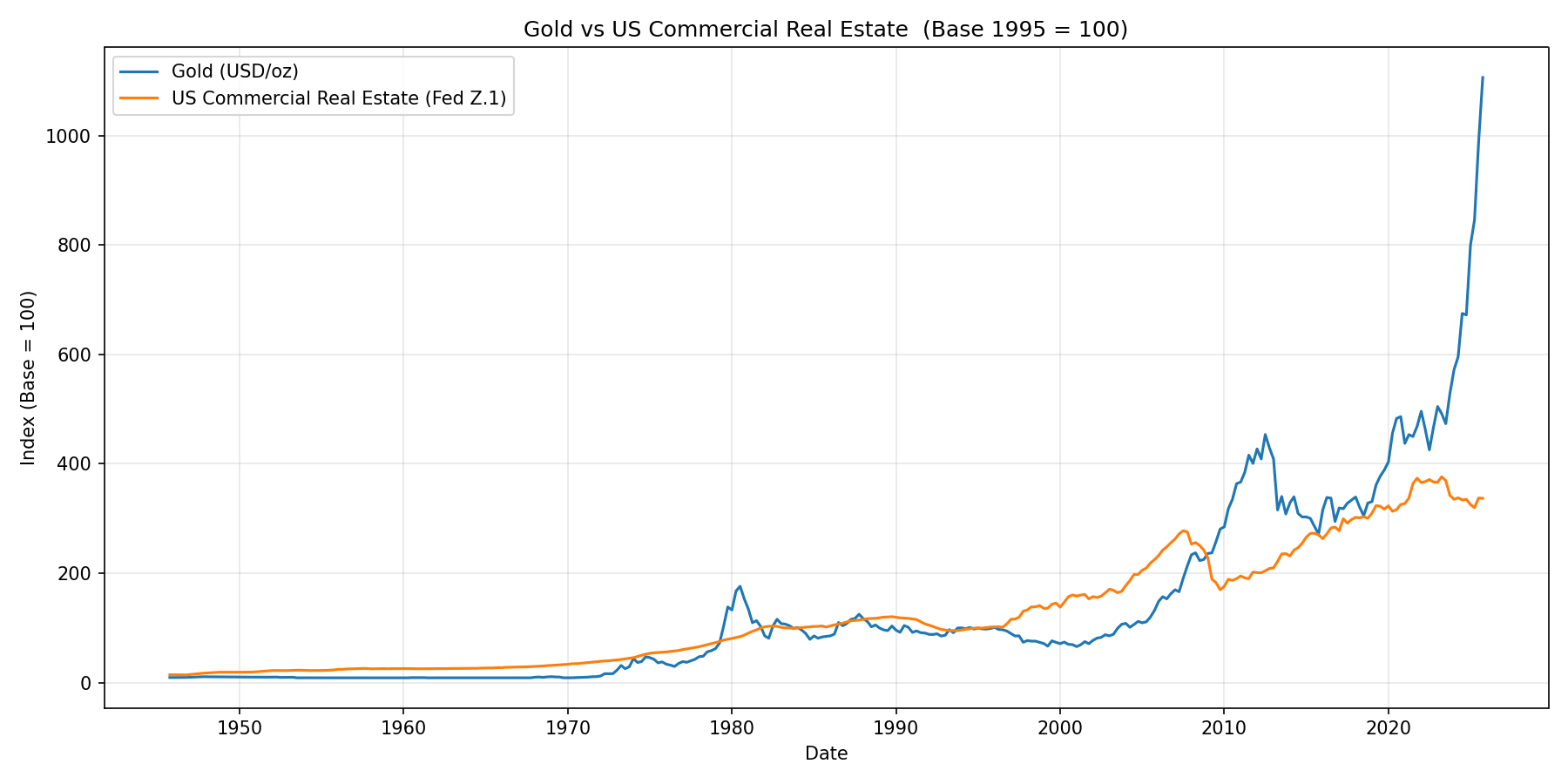
Now, to be clear, it didn't get it right on the first pass. We did have to make a couple of edits, but once we did get it right, the script ran, and it kicked out two PNG images. One showing gold and commercial real estate plotted side by side, and one showing the ratio between them.
What the data shows
To be clear, this blog is not financial advice, and I'm not predicting where any market is heading.
Looking at the first chart — gold versus commercial real estate, both indexed to 1995 = 100 — you could be forgiven for thinking that, up until the recent spike in gold, the two asset classes had stayed roughly on par. The lines track each other reasonably well for long stretches.
But the ratio chart tells a different story. When you divide one by the other, clear cycles emerge. There are distinct moments when gold spikes well past commercial property, and periods where commercial property steadily outperforms gold. The 1970s stagflation era, the post-2008 financial crisis, and the current moment all stand out as periods of dramatic gold outperformance.
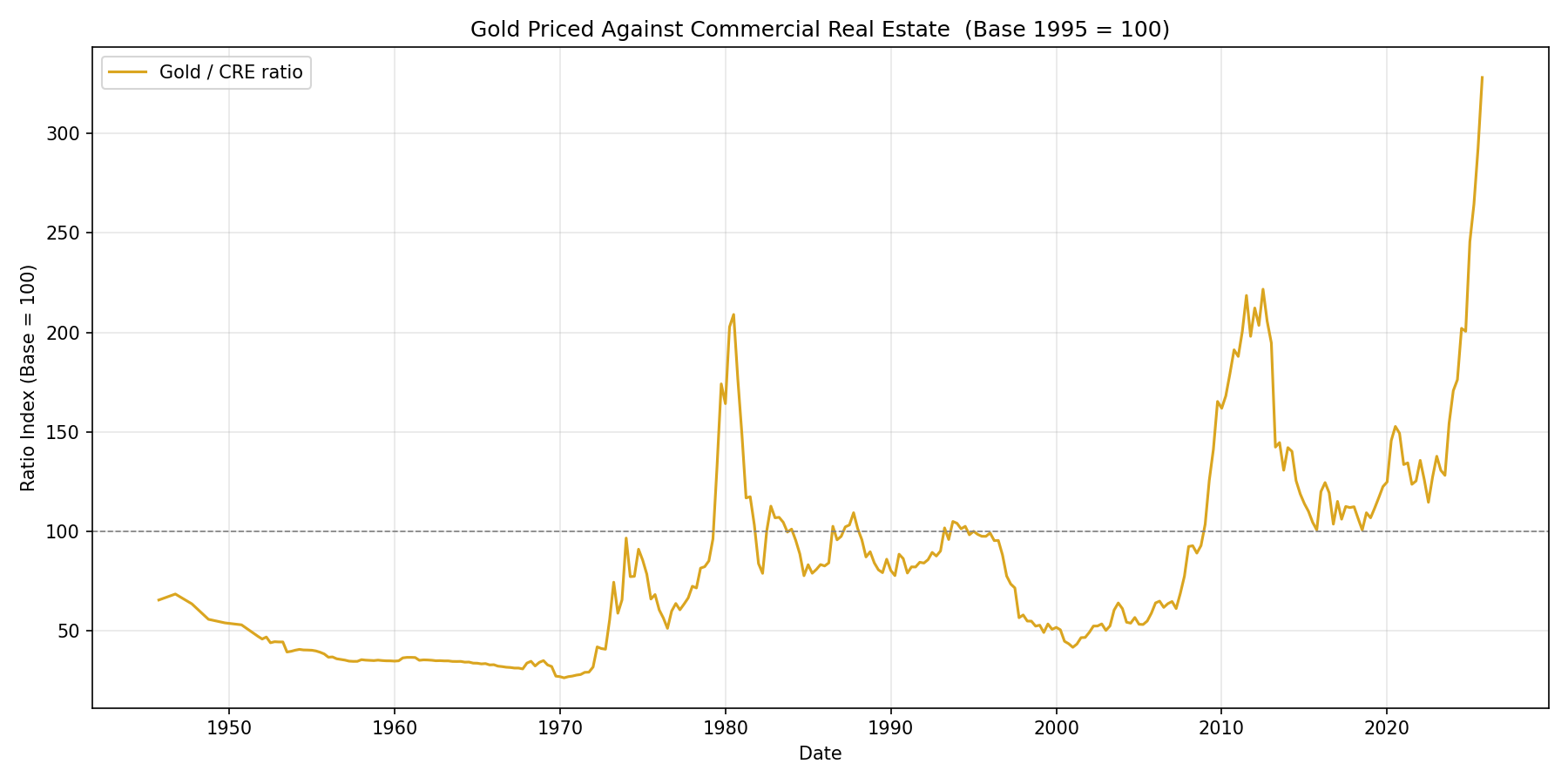
What does this tell me? As an investor (again not as a financial advisor) being able to see these two charts side by side, I can identify moments when it might be advantageous to rotate from metals into commercial real estate, or to rebalance a portfolio around those spikes. Both series have been adjusted to a common baseline, so the ratio gives you a genuine picture of their relative value over time.
Of course, this doesn't take into account that an investment in commercial real estate can have a positive cash flow and an investment in gold often has a negative cash flow in storage costs.
The point
But this article isn't really about what the data says. It's about the fact that I was able to produce it at all.
This is the kind of research that large investment managers or portfolio managers would have had a small team of interns build. Or it would have required an expensive subscription to a service like Bloomberg Terminal. The data existed, the methodology is nothing exotic, but the barrier to actually doing it — the coding, the data wrangling, the charting — meant that this kind of analysis was reserved for people with either technical skills or deep pockets.
That barrier is gone now.
I think there's a lot of confusion about where the real value of AI sits. People get caught up in the dramatic narratives. But for me, the value is in projects exactly like this one. A wandering thought on a Sunday morning, turned into a genuine piece of research in half an hour, by someone who can't write code.
The shift that matters for me isn't AI or sentient chatbots (and I have had a great debate with ChatGPT about if it is sentient). It's the democratisation of information. Smaller, more nimble businesses and investors can now act on the kind of curiosity that used to require a team or a budget. The wandering thoughts that run through your mind — the "I wonder if…" questions — those can now be answered. Quickly, cheaply, and by you.
That, to me, is the real story of AI right now. Have fun and stay curious.