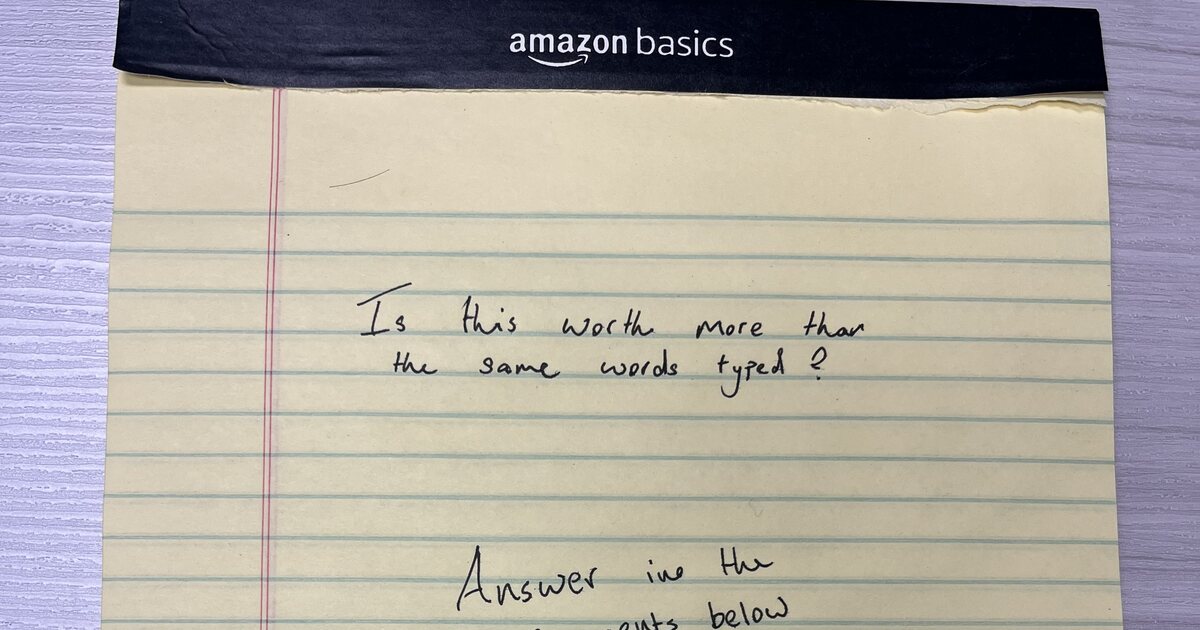
Someone I think of as a friend called me out on LinkedIn recently for using AI to write. It wasn't particularly rude, and I don't think he was acting in bad faith. The implication was that if a machine helped produce the words, the words count for less.
I told him I'd "write" up my answer, with my thinking and my process both. What he was getting at isn't completely invalid. There's a real debate to be had here.
Go back far enough and putting an idea in writing meant an inkwell, a reed pen, and a sheet of papyrus that cost a day or two of a laborer's wages, call it a couple of hundred dollars in today's money for a single sheet. You thought the whole thing through before you started, because the material punished mistakes and there was no second copy. Then came cheaper paper, the pencil, the fountain pen, the ballpoint. Then the mechanical typewriter.
The typewriter came on to the scene and people hated what it did to a letter. Victorian etiquette guides were clear that a typewritten personal letter read as cold, fit for business and not for a friend. A typed note said you couldn't be bothered to pick up a pen. I'd guess the same argument ran inside companies about memos, that a handwritten one carried weight a typed one didn't.
Then word processors, printers, and spellcheck. I'm dyslexic, and I first got my hands on a spellchecker at school. No piece of software has done more for me since. Before spellcheck, I could put a good idea on the page and have it marked down for the spelling around it. I don't think many people today would tell me my ideas are worth less because a machine caught my spelling.
Here's what I do now. I use Wispr Flow to talk, because I think faster out loud than I type. The ideas come out messy and in the wrong order, the way talking does. Then I work them over, sometimes with people, often with Claude, which will argue with me and tell me when a claim is loose or a number is wrong. Out of that comes a first draft. Then I go through the draft and cut, reorder, rewrite, and throw out the parts that turned out not to hold. What you're reading is what I signed off on.
The idea came out of my head. The argument is mine. I'm the one who decides what stays.
So criticize the idea. Tell me the reasoning doesn't hold, or the example is wrong, or I've talked myself into a conclusion the facts don't support. That's a real fight and I'll take it.
Criticize the curation too. If I've been sloppy, say so. Sloppy has always been fair game, and the tool has rarely been the point. You could criticize a handwritten note where the writer ran out of room and crammed the last word into the margin rather than hyphenate and drop down a line. You could criticize a typist who double-punched and left the page looking like a ransom note. You can criticize a Word document set in some crazy font, or one that went out with three spelling errors in the opening paragraph when the squiggly red line was sitting right there. Slop is not just reserved for AI.
AI slop is real, and I think it is a curation failure. Slop is what you get when someone takes the first output and ships it without applying any judgment to it. The tell isn't that a machine was involved. The tell is that the work went out unread by its own author.
What I don't think we should accept is "AI slop" used as a verdict on a tool instead of the work. That's the same move as refusing to read a typed letter.
I use AI the way I use a computer. I wouldn't write this on a typewriter, and I wouldn't hand-deliver it either. The tool I reach for says something about the year, and not much about whether the thinking is any good.
Edward Bulwer-Lytton wrote that the pen is mightier than the sword in 1839. The line lasted because he was right. Whatever he happened to be holding at the time isn't the reason anybody remembers it.
Postscript
While I was writing this, the same argument was running on a much bigger stage.
Stanley Druckenmiller published an op-ed in the Wall Street Journal on August 24 called "Let the Bond Market Speak," taking apart Treasury Secretary Scott Bessent's efforts to hold down yields on US Treasuries. It was read widely and taken seriously. Then the NOTUS reporter Jeff Stein asked whether he had used AI to write it, and Druckenmiller said of course he had. "I write everything using AI now for the same reason I use a calculator when I do math problems."
The All In hosts spent a good stretch of their August 29 show on it, and they did not agree.
David Friedberg reached for the same list I would have. Do artists disclose Photoshop? Do musicians disclose synthesizers? Do analysts disclose Excel? His better point is that "used AI" is too vague to mean much on its own. Spelling, grammar, research, structure, a full draft written for you, all of that gets filed under the same two words, and those are not the same act. David Sacks treated AI as part of the writing workflow now, sitting alongside spellcheck and the calculator, and said he uses it to fact-check and line-edit his own arguments. Chamath Palihapitiya called the idea of a disclaimer virtue signaling.
Jason Calacanis took the other side. He had already written on X that it was unforgivable for a public figure to publish an AI-written piece without disclosing it in the first sentence. On the show he compared it to lip syncing. If you buy a ticket to hear Adele, you want to know whether she is actually singing. His objection isn't to running a draft past a grammar check. It's to a reader thinking they have a great investor's own sentences when what they have is a draft he approved.
The performance analogy is where I think it comes apart. A concert is the thing itself, and the singing is what you paid for. Writing is a delivery mechanism for an argument. When I read Druckenmiller on the bond market, what I want is his read of the bond market and his name standing behind every claim in it. If the sentences got tighter on the way to me, I'm not the one who lost out.
The Journal landed in roughly the same place. Paul Gigot, who runs the opinion page, said Druckenmiller had broken no policy, and then named the standard he actually applies. Whether the piece reflects the author's own argument, and whether the author has the standing and the credibility to make it. Neither half of that test asks what software was open at the time.
Content can be slop with the tools or without them. What separates the two is the curation, and whose voice you decided was worth listening to in the first place.