I was in Svalbard from March 29 to April 6, 2026, on a PolarExplorers ski and pulk expedition out of Longyearbyen, six days in the field with two days in town at either end. It was training for a longer plan that runs through Greenland to the South Pole, and the trip itself, the people, and what the ice taught me are all in Pulking in Svalbard.
Half of what I believed about the place before I went turned out to be wrong, starting with the rifle I thought the law required. So everything below is checked against the offices that actually make the rules, with links.
What Svalbard actually is
Svalbard is part of the Kingdom of Norway, fully and legally. It is not a protectorate and it is not shared territory. What makes it odd is the Svalbard Treaty, signed in Paris on February 9, 1920 by nine countries and now numbering around forty-eight parties. The treaty hands Norway sovereignty on conditions. Citizens and companies of every signatory have an equal right to live there, work there, fish, hunt, mine, and trade, and Norway cannot discriminate by nationality when it applies its own law. Article nine forbids naval bases and fortifications.
Russia is the only other party that ever took up the commercial right at any scale, which is why people describe Svalbard as shared between two countries. It is not shared with anyone. Norway is sovereign, and forty-odd other states hold exactly the same access rights Russia holds and simply never used them. "Demilitarized" is wrong too. Norway reads article nine as a ban on bases and warlike use rather than on all military activity, Coast Guard vessels do call, and Russia disputes that reading. The argument is live and unresolved.
Three more things that matter to anyone actually traveling. Svalbard sits outside Schengen, outside the European Economic Area, and outside the Norwegian VAT area.
Who lives there, and where
Statistics Norway put the total population at 2,904 as of January 1, 2026. Longyearbyen and the research village of Ny-Alesund together account for 2,512, so Longyearbyen on its own is about 2,500. Barentsburg and Pyramiden together hold 392.
The number that separates Svalbard from a small town anywhere else is the churn. Median length of residence is about three and a half years, and roughly a fifth of the population leaves in any given year, against something like five percent turnover on the Norwegian mainland.
There are two towns, Norwegian Longyearbyen and Russian Barentsburg, and Barentsburg is growing rather than shrinking, up to about 390 across the last two years. But towns are not the whole list of inhabited places. Ny-Alesund is a working research village shared by ten countries. The Polish station at Hornsund has been staffed continuously since 1978. Norway has run weather stations on Bjornoya and Hopen year-round since 1947. And Pyramiden, which gets sold to tourists as an abandoned Soviet ghost town, is not abandoned. It holds twenty to thirty tourism staff in summer and one to three in winter, which is a small number of people but not zero.
Getting there, and the Oslo trap
Two airlines fly to Longyearbyen, SAS and Norwegian, from two airports, Oslo and Tromso. There are zero direct scheduled flights to Longyearbyen from anywhere outside Norway and there never have been. If you see a fare sold from London or Stockholm, it connects through Oslo. Oslo to Longyearbyen is about three hours and 2,012 km.
Because Svalbard is outside Schengen, there is identity and travel document control in both directions, including for Norwegians. The part that catches people is where it happens. Longyearbyen runs no control of its own, so the check sits at the mainland end, which means you clear it northbound on the way out of Oslo. I did not appreciate how tight my Oslo transfer was until I was in it. Do not book a short connection in Oslo going north, and give yourself far more slack than a domestic transfer would need. If you need a Schengen visa to enter Norway, you need a double-entry one to get home again, because you leave the zone and come back. No visa is required for Svalbard itself.
The airport itself has one runway, 2,483 meters, no taxiways, laid on insulated frost-stable fill so the permafrost underneath does not thaw and swallow it. It is the northernmost airport in the world with scheduled public flights, and it handled a record 200,401 passengers in 2025.
Where to stay
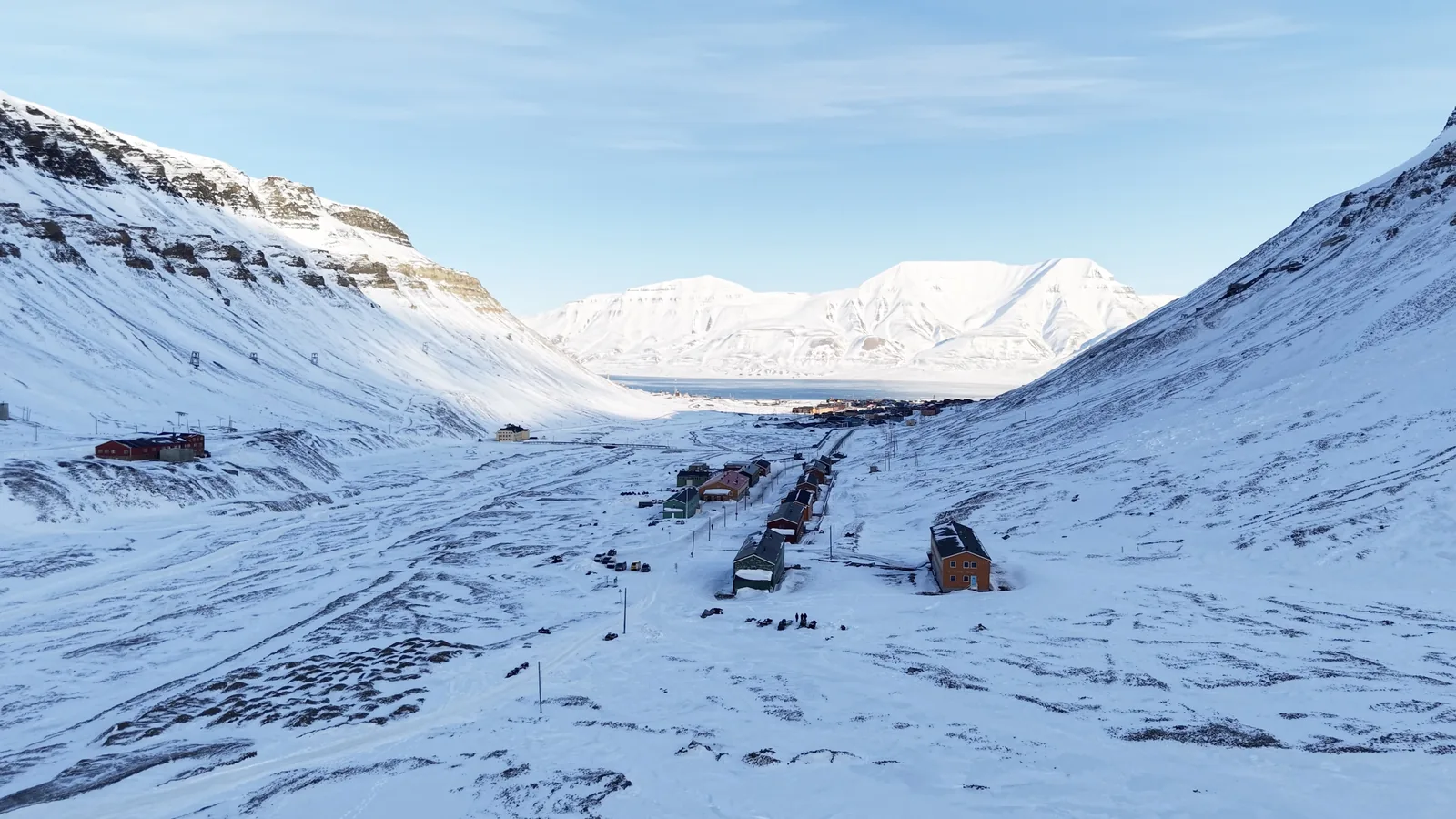
I stayed at Coal Miners' Cabins in Nybyen, up at the top of Longyear Valley. They are converted post-war miners' barracks, run by Hurtigruten Svalbard, about a twenty minute walk from the main street. Clean, comfortable, reasonably priced, and exactly what they say they are.
For the last night we moved down to the Radisson Blu Polar Hotel to treat ourselves. Comfortable, and expensive for what most Americans would recognize as a standard Hilton or Marriott room. It was not a super nice room. The breakfast, though, was fantastic, and after six days on the ice I sat in it for about three hours and ate my way through most of the cost of the room.
Two others. Mary-Ann's Polarrigg, where our guide stayed, is built out of old mining rigs, quirky in a way that is clearly deliberate, closer to town, and its restaurant Vinterhagen deserves a booking even if you sleep elsewhere. Funken Lodge is the top end of the market, a 1946 mine company building up on the hill. Hurtigruten Svalbard operates Funken, the Radisson, and Coal Miners' Cabins, so the same company runs the top and the bottom of the market.
Getting around
The airport shuttle bus stops at every hotel and guesthouse, Nybyen included, for NOK 110 one way, and it is timed to the flights. Two taxi firms run 24/7, Longyearbyen Taxi and Svalbard Buss og Taxi. Arctic Autorent rents cars at the airport. In summer you can borrow bikes from the Tourist Information Centre. Beyond the shuttle there is no scheduled bus network, because there is nowhere for one to go.
Why nobody walks to the airport
The airport is about five kilometers northwest of town, out on the Hotellneset peninsula. People will tell you not to walk it and the usual explanation is that it is too far, which is not really the reason. Five kilometers is nothing.
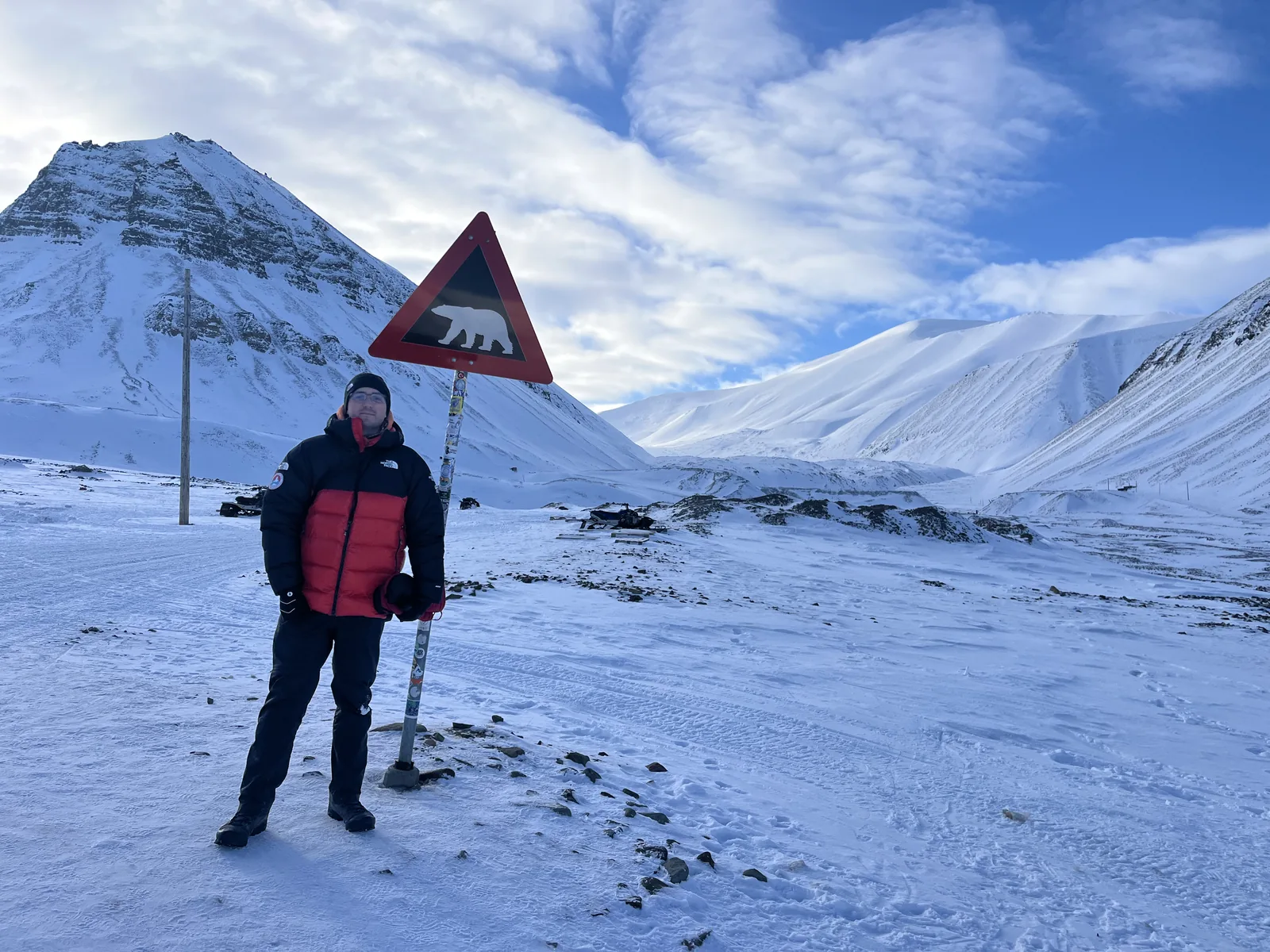
The reason is that the airport sits outside Longyearbyen's marked polar bear safe zone. One of the famous bear warning signs stands on the airport road down by the harbor, and once you are past it the shore road has no sidewalk for most of its length and nothing to shelter behind. What you will also read, and what is simply not true, is that walking it is illegal, that you legally need an armed guide, or that a firearm is compulsory. None of those three is the law. Take the shuttle because of the sign and the empty shoreline, not because of a rule that does not exist.
Bears, and the rule as it is actually written
Section 30a of the Svalbard Environmental Protection Act requires anyone traveling outside the settlements, other than people taking part in organized tourist activities, to know something about polar bear safety and to carry "suitable equipment to frighten off and chase away polar bears." The deterrent is what the law demands. A firearm is what the Governor recommends. Those are different things, and a flare gun satisfies the duty. Bear spray, which many Americans would reach for first, is illegal in Svalbard.
The distance rules are firm. Stay at least three hundred meters from a polar bear, five hundred meters between March 1 and June 30, and if a bear closes on you the obligation is to retreat.
The Barents Sea subpopulation, which Svalbard shares with Russia, came in at about 2,650 bears in the 2004 joint survey, with a stated range of 1,900 to 3,600. A 2015 survey of the Norwegian side found no reduction despite heavy sea ice loss. There has been no whole-population estimate since, because the Russian half has not been surveyed, so anyone quoting a crisp current figure is guessing. Five people have been killed by polar bears in Svalbard since 1971, most recently in 2020 just outside Longyearbyen.
They do come close to town. On June 16, 2026 the Governor drove a bear out of Bjorndalen and Vestpynten and used a helicopter to push it into Isfjorden and away, which is the airport side of town, the same shoreline as that walk. I saw no bear at all. Six days on the ice, a rota of two-hour night watches, a rifle and flare guns in camp, and the only thing that ever came near our tent was a small bird that got me out of the door faster than I have moved in years.
Rifles, the practical version
Loan permits come from Sysselmesteren, the Governor of Svalbard, who is also the police there. Not a mayor, whatever the blogs say. There is one application process, and a few exemptions that let you skip it entirely.
First, the timing, which is the part most sites have wrong. The Governor's own firearms page, updated March 9, 2026, says in bold that high demand has pushed processing for all weapons applications to up to eight weeks. Third-party articles still say four. Work on eight weeks minimum and two to three months to be comfortable. Second, check whether you need to apply at all, because if you are over eighteen and hold a valid Norwegian firearms license or a European Firearms Pass, you do not. Third, if you do apply, the English form is at skjema.no/sysselmesteren/utlanvapenengelsk, the fee is NOK 248, and the permit runs up to four weeks. Fourth, a US applicant has to document "sufficient firearms proficiency," and the accepted examples are documented sport shooting, completed military service, or a completed approved weapon-handling safety course. In practice that means a state hunter-education certificate or an NRA course certificate. A concealed carry permit is not on the list.
Only bolt-action rifles in .308 Winchester or .30-06 Springfield are approved for bear protection, and two shops in town rent them. Each offers an old Mauser and something modern.
At Sportscenteret Svalbard, the Mauser .30-06 runs NOK 400 a day or 2,000 a week, and a modern lightweight rifle runs 500 a day or 2,500 a week. They also rent flare guns at 300 a day and a tripwire bear alarm for your camp perimeter at 30 a day. At Longyear78, the Mauser M98 is 400 a day or 2,400 a week on a walk-in basis only, the Ruger M77 can be reserved ahead at 600 a day or 3,000 a week, and flare guns are 200 a day.
The flare gun needs no license at all, rents to anyone over eighteen for a couple of hundred kroner a day, and satisfies the legal duty on its own. In Longyearbyen itself, loaded firearms are forbidden, weapons must be carried visibly empty, and they never go into shops or public buildings.
I did not know about the permit before I traveled. I wish I had, because I would have done it.
The coal, and the timing
Longyearbyen exists because of coal, and the coal is more interesting than "there was a lot of it." It is Paleocene high-volatile bituminous hard coal, a proper hard coal rather than lignite, out of a seam roughly a meter and a half thick. It is not low sulfur. The deposit is marine influenced and runs over half a percent sulfur.
What made it irreplaceable was one customer. Clariant bought Mine 7 coal for about forty years, ground it to powder near Munich and in Bilbao, and blended it with bentonite to make foundry green-sand molding compound, the sand mix that metal casting molds are formed in. Their line was tuned to that specific coal from that specific hole in the ground.
Production at Mine 7 stopped on June 30, 2025. On May 4, 2026, the mine was physically sealed, the entrance closed and the key thrown into the tunnel. That was the last coal mine Norway had anywhere, ending 110 years, and mining at Longyearbyen began in 1906 under the American Arctic Coal Company, which is where the town's name comes from. The coal power station, Norway's last, closed in October 2023, and Longyearbyen now runs on diesel plus a six megawatt battery. Barentsburg is the only active mine left on Svalbard and the northernmost in the world.
Wildlife, calibrated
The Svalbard reindeer is an endemic subspecies and the smallest of them, short-legged and stocky. There are about 22,000 in the archipelago, Adventdalen alone holds somewhere between seven hundred and seventeen hundred, and they graze between the houses without much interest in you.
Birds around town in season are genuinely good. Common eider nest close to the center toward Adventdalen, including between the dog kennels. Pink-footed and barnacle geese, purple sandpiper, glaucous gull, kittiwake, Arctic skua, Arctic tern, and snow bunting are all reasonable expectations. The Svalbard rock ptarmigan is the only land bird there year-round, and land is the operative word, since eider and a few others overwinter on the coast. An Arctic fox was working the eastern wall of the valley just up from Coal Miners' Cabins while I was in town. I never caught sight of it myself, but a woman I met had.
Two things get promoted as Longyearbyen wildlife that are not. Walrus is normally a full day boat trip, to Poolepynten or into Borebukta. I saw mine from the airport bus, sitting out in the fjord, and I would not plan a trip around that happening twice. Puffin and little auk are excursion species too.
The Seed Vault
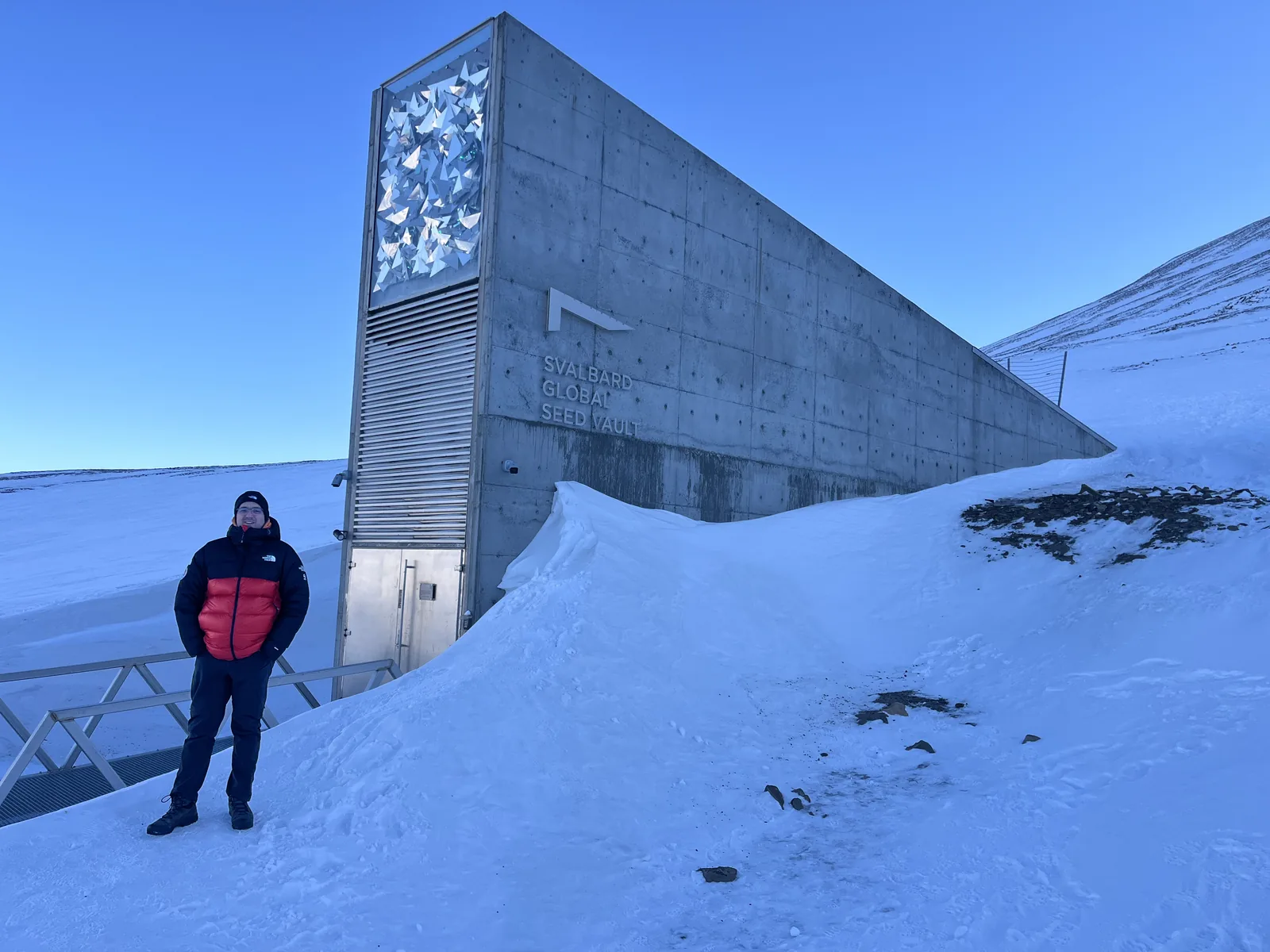
The Global Seed Vault is worth seeing, and the way to do it is to have a taxi drive you out there and then literally drive you straight back. There is not a lot there beyond the doorway in the mountainside, and you cannot go in, but it is the doorway everyone recognizes. The data vault nearby, the Arctic World Archive, is much less impressive.
Money
Everything is expensive. Food, restaurants, beds, gear. Not surprisingly expensive, given the freight distance, but budget as though every meal costs half again what you expect and you will be about right.
What changed on January 1, 2026
The Field Operation Safety Regulations came into force on January 1, 2026 and replaced the old field travel rules, which dates a lot of the advice written before that. Outside the defined travel area, four things now apply. First, you have to apply to the Governor at least four weeks ahead and receive an answer before you leave, so silence is not permission. Second, you must carry two-way communications. Third, search and rescue insurance is mandatory, at NOK 120,000, 350,000, or 650,000 depending on the zone. Fourth, you file a report after the trip within four weeks. Separately, a guide approval scheme becomes mandatory for operators from July 1, 2027.
All of which is a good reason not to trust any of the above for longer than a season. The rules here move, and they moved twice while I was researching the trip. Read sysselmesteren.no and visitsvalbard.com before you book anything, and treat what I have written as a starting point rather than a source.