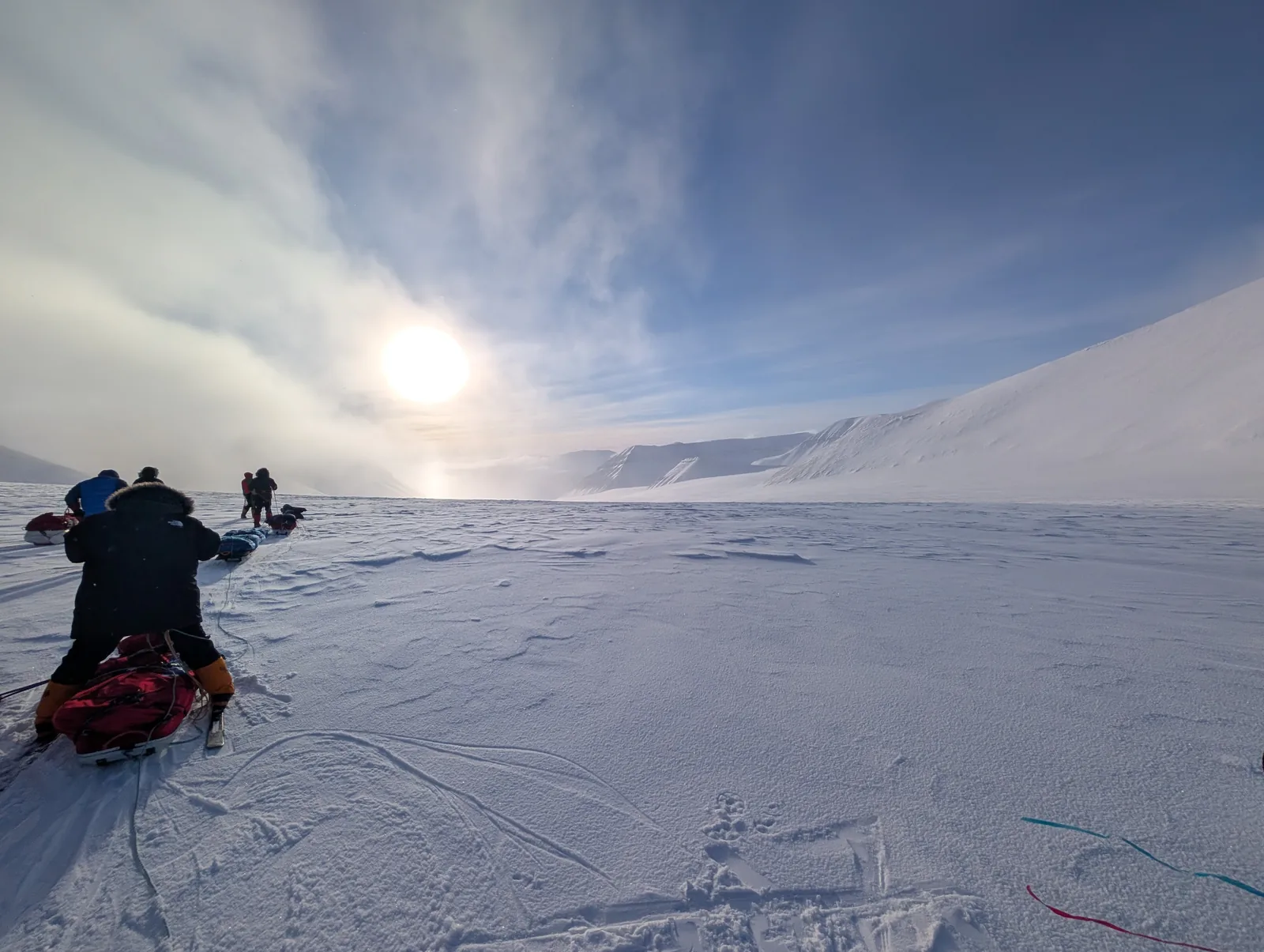
The plan is to ski to the South Pole from the coast, and when I booked this training trip to Svalbard I had spent a handful of nights in a tent in my life. I had never pulled a sled. I had never cross-country skied. I had never slept on snow.
If you want to go to the South Pole, you can only read so many books or websites before you actually need to go out there and give it a go. So you buy the smallest real version of the thing and find out whether you can do it, and whether you even like it. The smallest real version turned out to be six days and five nights on the ice above Longyearbyen, at 78 degrees north, with a company called PolarExplorers.
This is that trip. What it was like, what it taught me, and what I got wrong.
The people I went with
I have been playing with the South Pole idea since 2018. In early 2019 I flew to New Zealand and took a helicopter onto Franz Josef Glacier, five nights up there learning crevasse rescue and glacier travel. The place was extraordinary and I would send anyone.
The guide was another matter. On the first day, rather than the viewing point up on the valley wall, he walked us back down and along the valley floor toward the base of the glacier. That ground has been off limits since 2012, when the terminus shed about seventy meters and left the ice and rock above it hollowed out. One of our group turned an ankle on the way in. A New Zealand guide watched where we were heading and said we were walking into death valley.
I thought then about not going up with them.
What followed was a week of a man doing the things he wanted to do. He piled loose gear on the helipad after the pilot had told him not to, because anything loose goes into the rotors. He rigged lines that dragged. He took us up forty five degrees of shale, unroped, on a day it had thawed, because he wanted the summit. He was in a hurry, and none of the hurry was about teaching us anything.
I am not going to name the company, and the lesson was never really about them. It was that I had seen enough on the first day to walk away, and I went up anyway, because I had already decided to be there.
I had booked that trip the way you book a vacation, on itinerary and price, and I never looked hard at the people taking me onto the ice. In places like this the people are most of the safety, and they were the one thing I had not checked. I have chosen the people first ever since.
After this trip, my South Pole expedition got put on hold by a pandemic, a wedding, and two children, in roughly that order. The plan went in a drawer for six years. In 2025 I took it back out and booked the training trip.
This time I started with the people. The polar training market is small and the same names come up quickly. I emailed several and got on calls.
The conversation that decided it was with Annie Aggens, who runs PolarExplorers. Nothing in it was a sales call. I asked her a straight question, whether the trip is more physically demanding or more mentally demanding, because I like to think I carry oodles of both and I wanted to know which one I was going to bump up against. She danced around it. It lands differently on different people, she said, and it is just different. I had wanted a benchmark, and the real answer is that there is not one. She did not once try to move me toward a booking, and by the end of the call I had the impression of people who cared what happened to their clients, which after 2019 was the only thing I was really looking for.
PolarExplorers has been running since 1993, when Rick Sweitzer organized the first North Pole dogsled and ski expedition for amateurs. They have guided more than five hundred people on polar expeditions and trainings, and Annie sits on the board of the International Polar Guides Association. Keith, my main guide on this trip, has a dozen or more North Pole, South Pole, and Greenland expeditions behind him, including a full South Pole on the Messner route.
Why Svalbard and not Minnesota
PolarExplorers run their polar training in two places, out of Ely, Minnesota and out of Longyearbyen. I looked at the price of both, and money was never a deciding factor. They cost within a few hundred dollars of each other. The question was which one gave me more, and it was not close.
Svalbard put me in a tent for five nights out of five. Minnesota is lodge-based, with two nights on the snow in the middle and hot showers waiting at the end. I was buying nights on the ice, and Svalbard sold more than twice as many of them for roughly the same money.
Minnesota does have one thing Svalbard does not. They cut a hole in a frozen lake and teach you how to get yourself out of it, which matters for anyone heading to the North Pole, where you can break through. I did not get that and I would like it someday.
Mostly, though, I am an adventurer. I love going to places that take some getting to, and Svalbard is one of the most adventurous places you can reach on a scheduled flight. Minnesota is there whenever I want it. The high Arctic is not. I live in Kansas City, I have family in England, and routing through London meant the trip could do two jobs at once. From the UK, Svalbard would not even have been a decision.
Six months of getting ready
I trained for about six months.
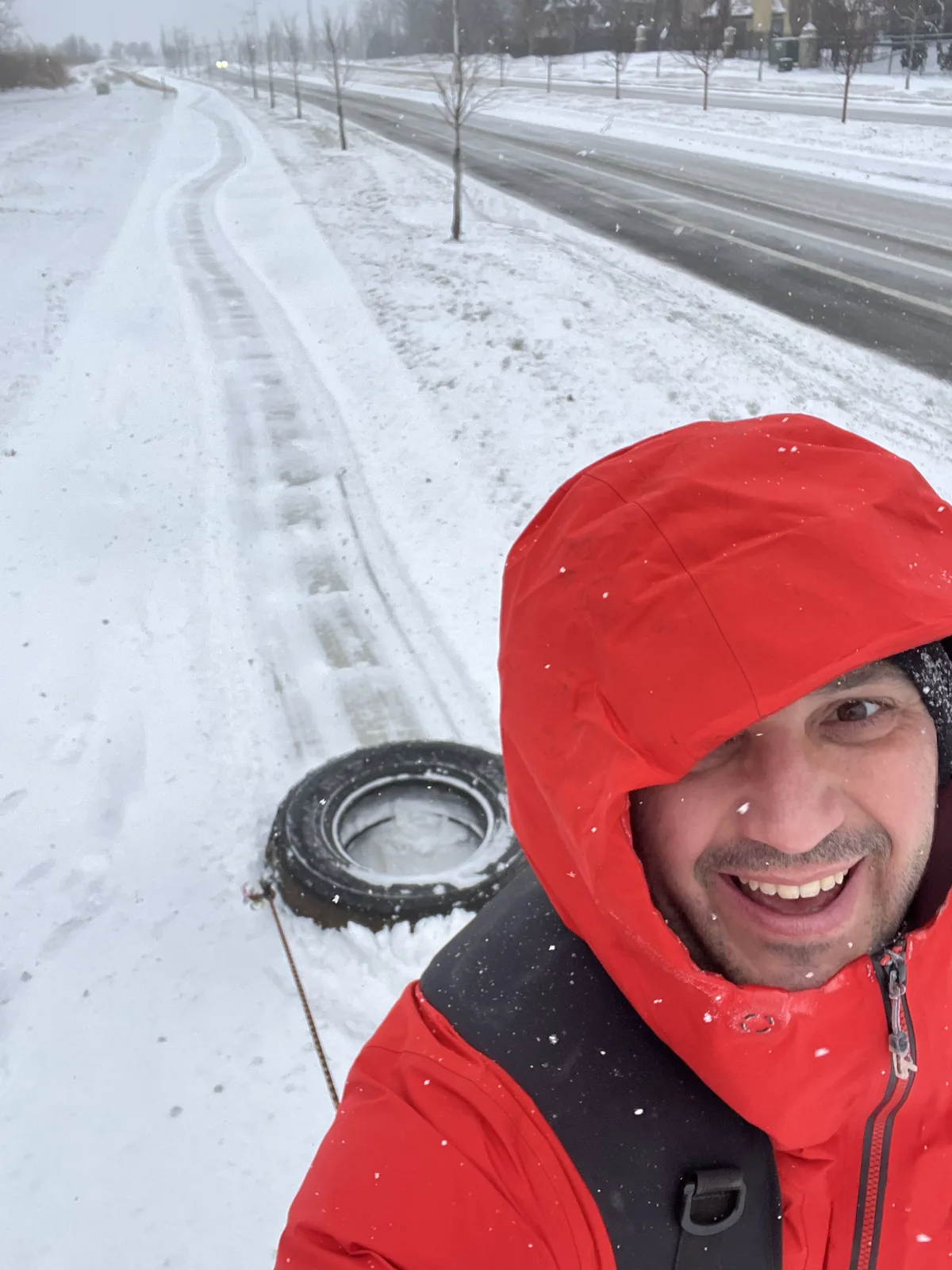
First, rucking. My pack carries a 45 pound plate and two six pound dumbbells, 57 pounds all in, and I walked three or four miles with it once or twice a week. Second, Zone 2 on the rowing machine, 10,000 m (which I could do in 42 minutes) at a time, two or three times a week, with a heart rate monitor propped on my phone so I could hold the zone instead of drifting out of it. Third, tire pulling, with the same harness I would later wear on the ice, so the sensation would be familiar rather than new.
The tire came out of a nature reserve outside Kansas City, where somebody had dumped it. I cleaned it up, put two eye bolts through it with washers so it could be hauled from either side, and cut rope to roughly the length of a pulk's traces. A few dollars of hardware.
The thinking behind all of it is that this is not a strength sport. You want strength for specific failures, getting yourself out of a crevasse being the obvious one, and for making and breaking camp with cold hands. But the thing that decides whether you finish is endurance and Zone 2. I was not the strongest person on the trip. I was among the fastest on skis with the ability to go for the longest.
Dan, one of the Americans with us, is a long-distance cyclist and arrived with exactly the right engine. Andrew was fit and had solid Zone 2. Neither had done any of this before either.
I wore a Whoop the whole way, so I do not have to guess. Across six days on the ice I recorded 31 hours of movement. Forty-six percent of it sat in Zone 1 and 36 percent in Zone 2. Fifteen percent was Zone 3. Zone 5 never happened once. Four fifths of the work was in exactly the zone I had spent six months training.
The kit, briefly
I have written the kit out in full elsewhere, item by item, with what I paid and why, so I will keep this short. The whole list is here.
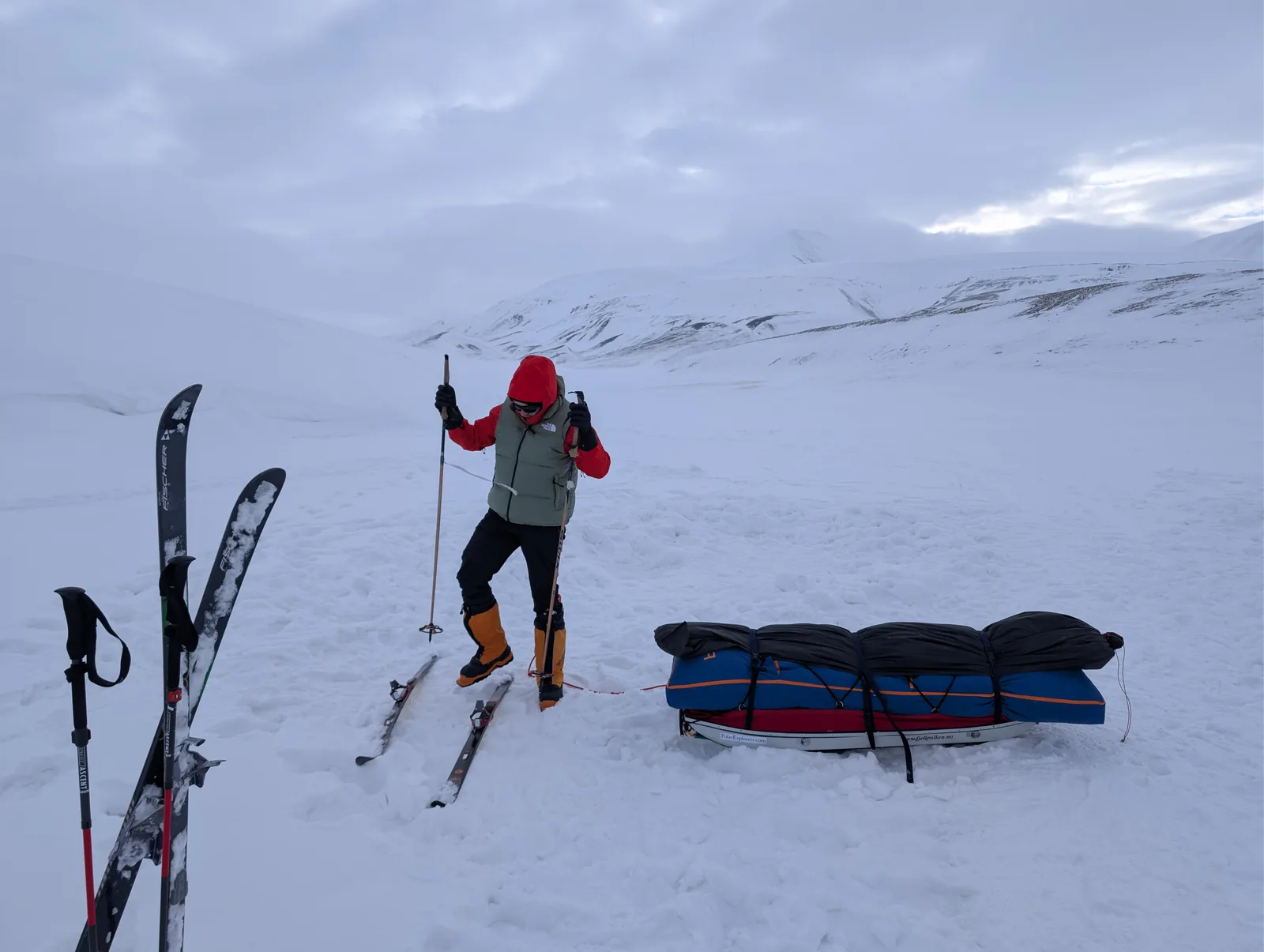
PolarExplorers provided boots, skis, poles, tent, sleeping bag, and sleeping mat, which takes a huge amount of weight and bulk out of your flights. Chris, our second guide, went through my kit on a video call weeks beforehand, and then Keith went through the same kit in person in Longyearbyen. The second pass was not redundant. Somebody picking an item up and turning it over finds things a spreadsheet does not.
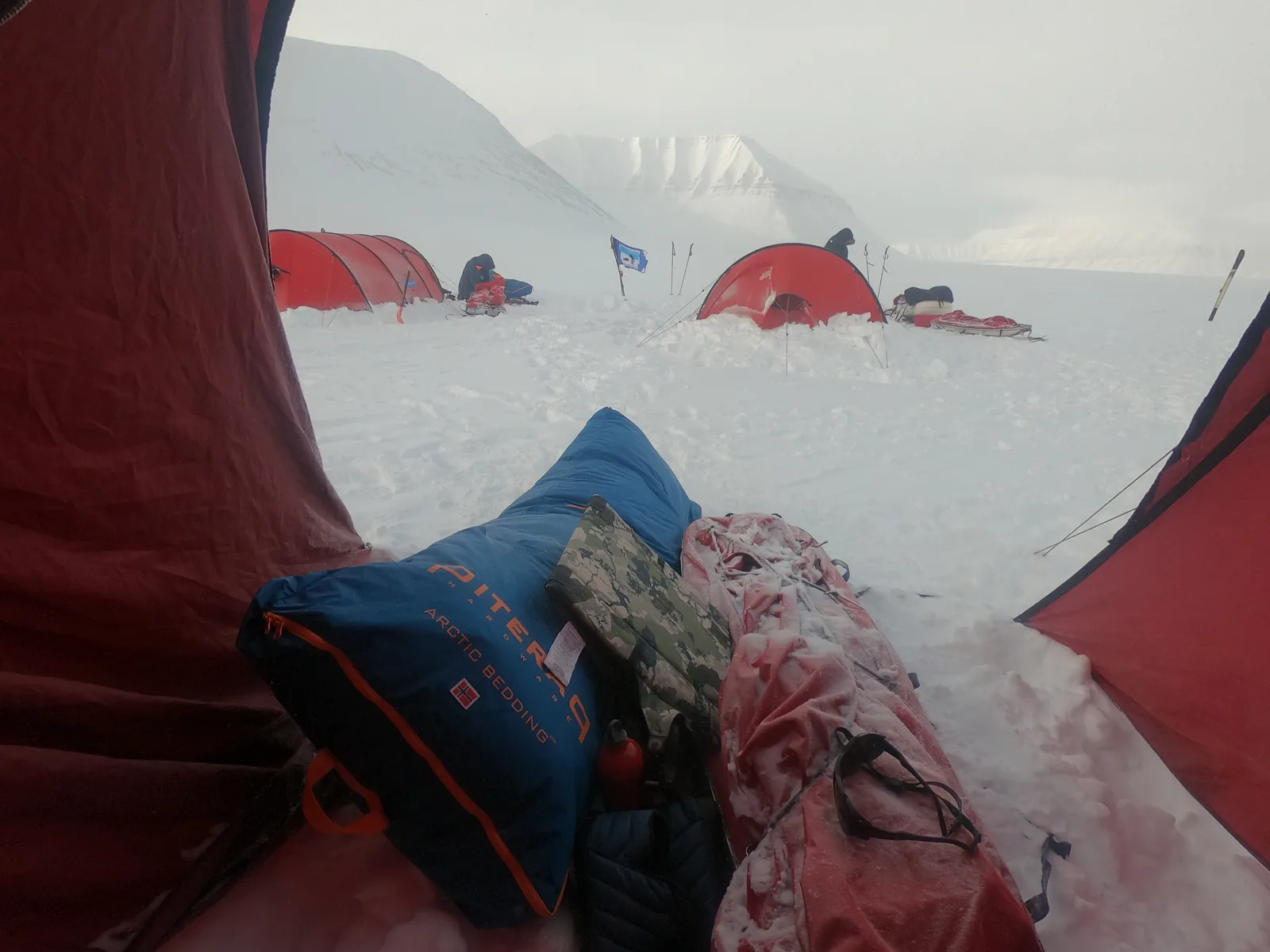
And Longyearbyen has real outdoor shops, which is a safety net most people do not realize they have. I bought my pulk bedding bag there, a Nordic Life Piteraq, and it turned out to be one of the best purchases of the trip. It sits on top of the sled with the foam mat, the inflatable, and the sleeping bag already inside it, and the pockets on top carry the next twenty-four hours of food and water. Setting up camp becomes pulling one bag off a sled and unzipping it.
Getting there
Kansas City to England on a oneworld routing, British Airways and American Airlines, with a short stop to see my parents. Then Norwegian from Oslo to Longyearbyen, about three hours and 2,012 kilometers north.
The catch is the border. Svalbard is Norwegian, but it sits outside the Schengen area, so there is identity and travel document control in both directions, including for Norwegians, and the checks happen at the mainland end rather than in Longyearbyen. I had not understood how little time that left me in Oslo, and the transfer was tighter than I ever want again. Do not book a tight Oslo connection northbound. And if you need a Schengen visa at all, you need a double-entry one, because you have to come back through mainland Norway to get home.
I met Andrew at the airport, along with three of our group over from Japan.
Andrew was a colleague, and he was on this trip because of a conversation he had had with a colleague called Rick at a Panda Express. They had got onto the subject of some of the things I do with my spare time, and Rick observed that Andrew did not have any stories as good as mine. Andrew brought this up with me in jest, and I said to him, "Well, you should come on this trip to Svalbard so that you have one." He said yes.
People say yes to these invitations all the time. What normally follows is a withdrawal over the next couple of months, usually with a good reason attached. Andrew has decided to say yes to every trip he is invited on and then actually go, which is a harder policy than it sounds. So he came, and I think it surprised both of us.
He has no interest in the South Pole at all, best I can tell. What he liked was the kit, the problem-solving, and the place. He would describe himself as a bit of a geek, and he is also a serious outdoorsman, and out here those are the same thing. Svalbard works perfectly well as a standalone trip with no larger plan behind it, and several of our group were there on exactly that basis.
The flight north gave us a first taste of the place. Andrew got talking to a Norwegian woman who had trained as a doctor, decided she did not want to be one, gone to Thailand, and was now on her way to pull a pulk across the whole archipelago. Andrew, being American, could not work out how anyone walks away from the cost of a medical degree. She explained that in Norway there is no cost to walk away from.
The extra day
I always build a spare travel day into trips like this, and I landed in Longyearbyen a full twenty-four hours before I needed to be there.
A spare day is not about comfort. If a bag misses a transfer or a leg goes late, you are not inconvenienced, you are removed from an expedition that leaves without you. The expedition is priced, staffed, and permitted, and it goes whether you are standing there or not. A day of hotel costs is cheap insurance against losing the whole thing.
Nothing went wrong, which is how it usually goes. The day became my first look at the town, and a test flight.
Svalbard itself
I have written the practical version separately, hotels, transport, rifles, wildlife, what things cost. That is here.
Svalbard is Norwegian, but a treaty from 1920 gives citizens of dozens of countries an equal right to live and work there, and Russia is the only one that ever took the offer up properly. So Norway runs Longyearbyen, Russia runs a settlement called Barentsburg further along the coast, and the two communities have spent decades in a kind of long-running neighborly wind-up. The way it was told to me while I was there, each side likes to go and fly its flags near the other's town, just to make a point, and the other side then does the same back. Apart from that, it is all pretty relaxed up there.
It is small. The airport is incredibly tiny, a single runway and not much else, and the whole of Longyearbyen is about 2,500 people.
The whole place exists because of coal, and I was there at the end of it. There was a geologist in town who seemed to be very excited and wanted to explain the full history behind the geology there, and I confess I did not follow all of it at the time. A month after I flew home, Norway's last coal mine, just up the valley from where our trip started, was sealed for good and the key was thrown into the tunnel.
Everything is expensive. Food, restaurants, beds, all of it.
I saw reindeer, an endemic subspecies, short-legged and stocky, grazing between the houses. I saw a walrus from the bus to the airport, sitting out in the fjord. The normal way to see one is a full-day boat trip, so I am counting the bus as luck. And then there are bears. The roads out of Longyearbyen end at signs, and the signs are the edge of the area where you are expected to be able to look after yourself. The airport is five kilometers away on a spit of land outside that boundary, which is the actual reason people tell you not to walk it. It is not illegal and the distance is not the problem. The problem is a shore road with no sidewalk and nothing to get behind. In June this year the Governor used a helicopter to move a bear off exactly that side of town.
The drone
I wanted aerial footage, and flying a drone at 78 degrees north turns out to be its own small discipline. I have written that up separately.
The short version is that you register as a drone operator with the Norwegian authorities and mark the number on the airframe, and a sub-250 gram aircraft keeps you in the simplest category, which is why I flew a DJI Mini 5 Pro. The whole of Longyearbyen sits inside a five kilometer prohibited zone around the airport, and only the airport tower can lift that, not the Governor.
Before flying I overlaid the official drone map on Google Maps. The boundary crosses the valley just above Nybyen, where I was staying, almost exactly where the road ends at the polar bear sign. Coal Miners' Cabins sits about 130 meters inside the line. Walk a few hundred meters further up the road and you are out. From up there you get a clean shot down the valley toward town, past abandoned mine buildings that photograph well. That is where I tested how the aircraft behaved in the cold.
Two days before the ice
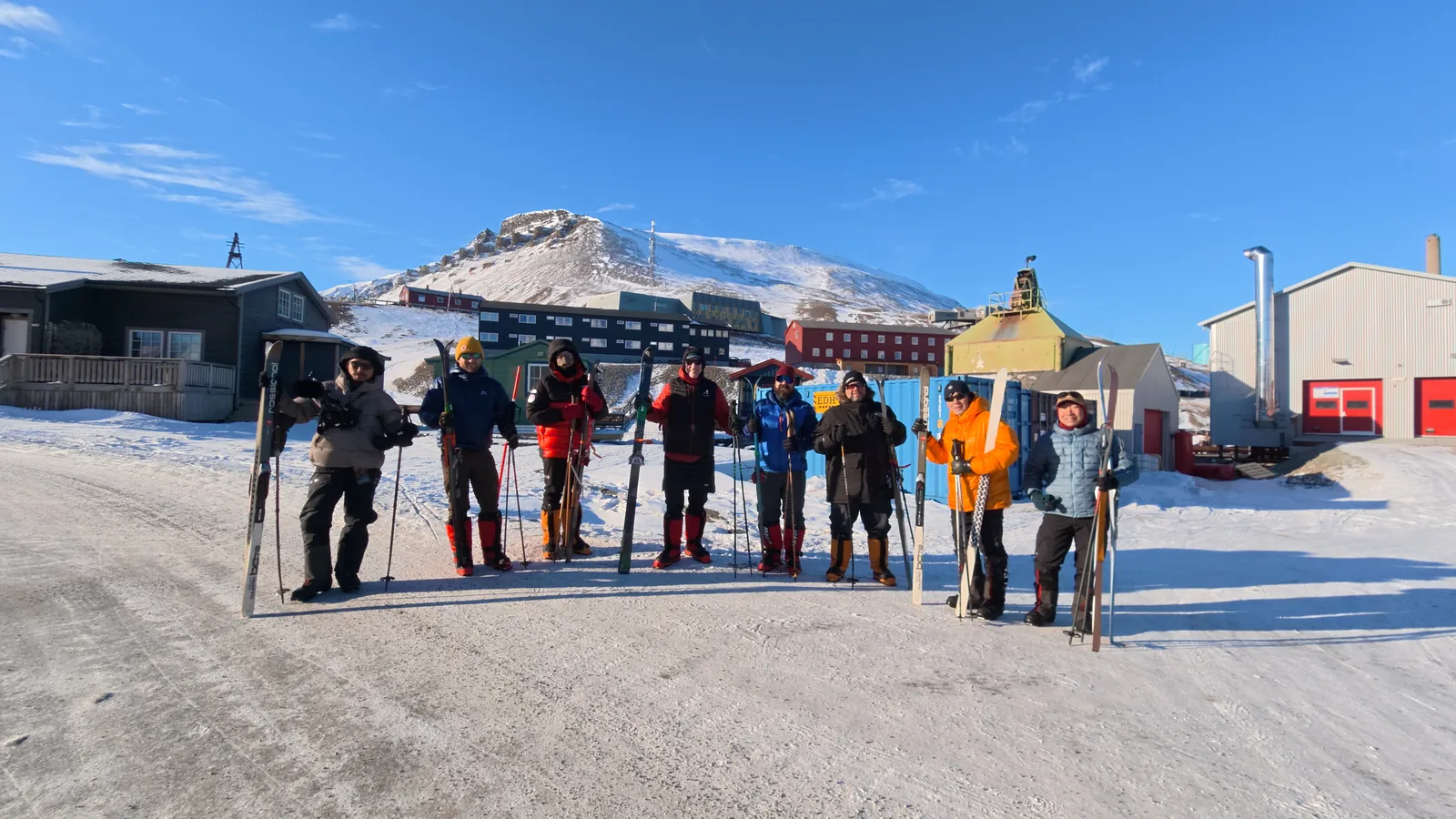
Keith came to the hotel and went through everything Andrew and I had brought, item by item, with an opinion on each. Then we got sized for boots, skis, and poles, and went out onto the frozen river in town to learn what we would be doing for a week.
If you have never cross-country skied, the motion is a push and a glide. The ski has a friction pattern or pad, like a felt insert, under the foot that grips going backward and releases going forward, so you drive the ski forward, transfer your weight onto the front foot, and roll through. It is not walking with long shoes on. There is a rhythm to it, and the rhythm is where the speed comes from.
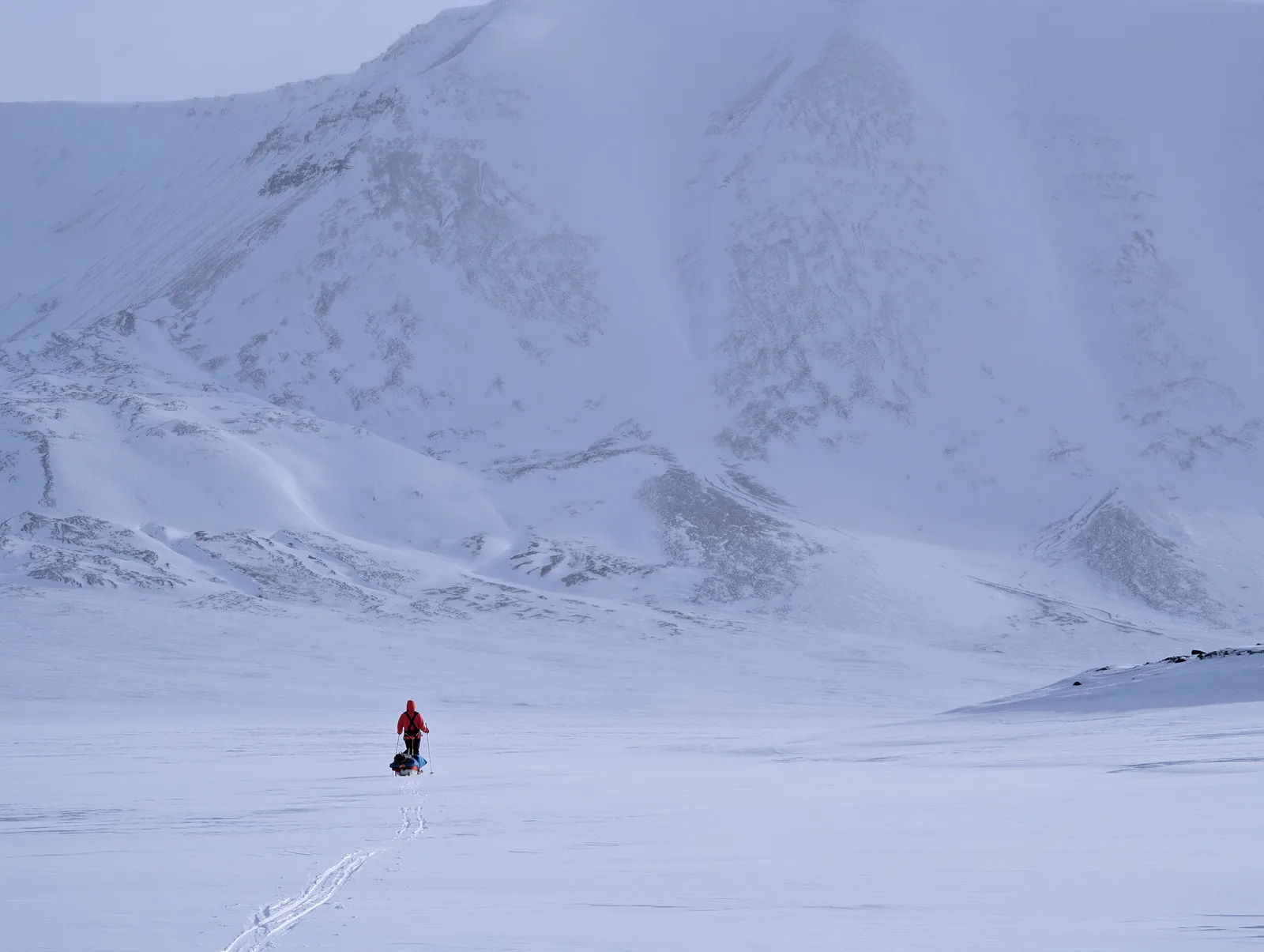
Then you clip a harness around your waist, attach it to a loaded sled, and discover it is a different sport. The sled does not pull back at a steady rate. It surges when you accelerate, it drags when the snow is wet, and on any slope it either hauls you backward or tries to overtake you.
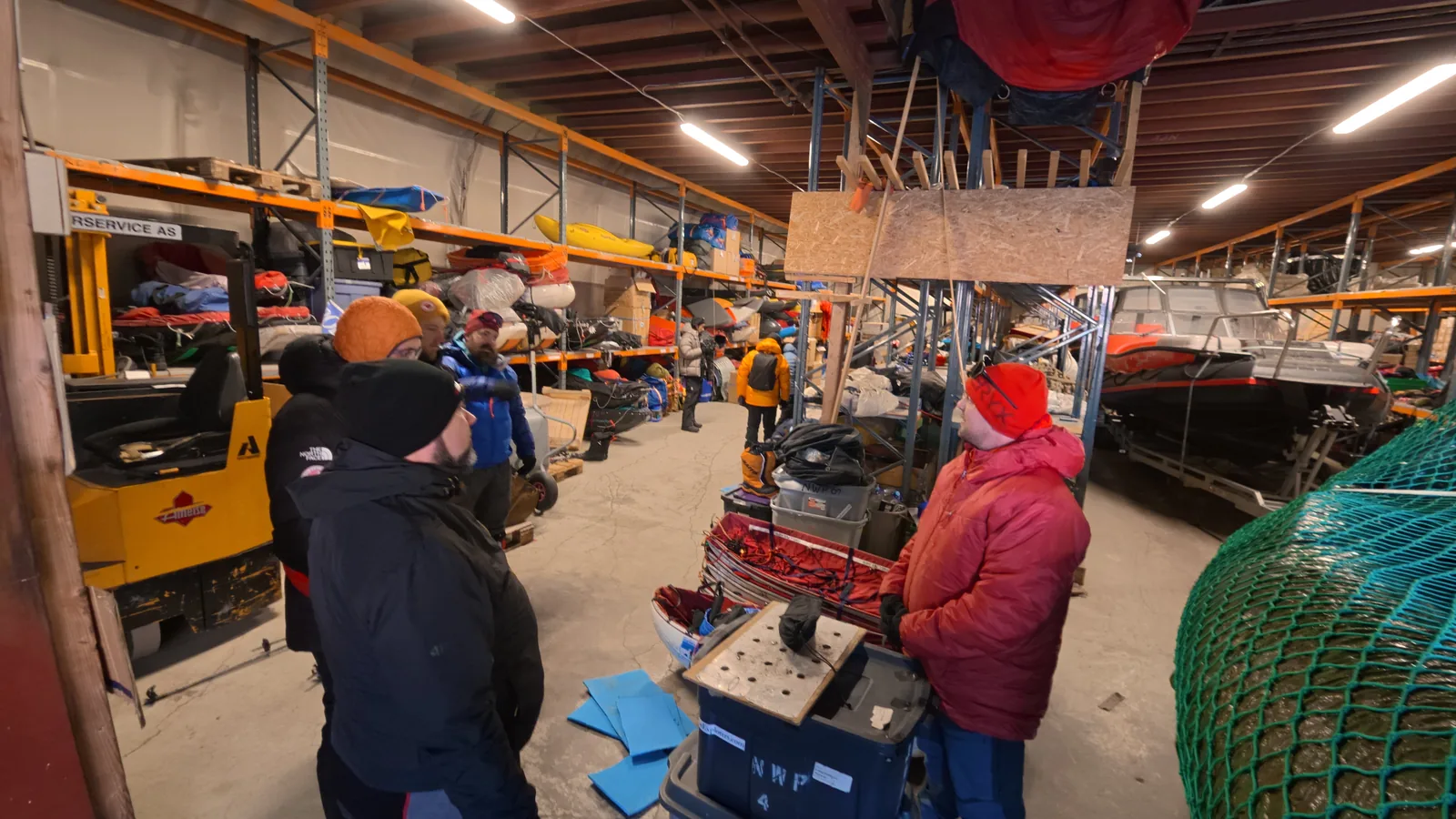
The last job that evening was loading up the pulk in the hangar. I traveled with a duffel, but nothing stays in a duffel. Everything goes directly into the sled, under a fabric expandable top with bungees over it, and the Piteraq bag rode on top with the next day already assembled inside.
Six days
A taxi minivan towing a trailer took us and the sleds out to Camp Barentz, about eleven kilometers up the valley from town, where the main cabin is a replica of the hut Willem Barentsz overwintered in on Novaya Zemlya in 1596. It was both the start line and the finish line.
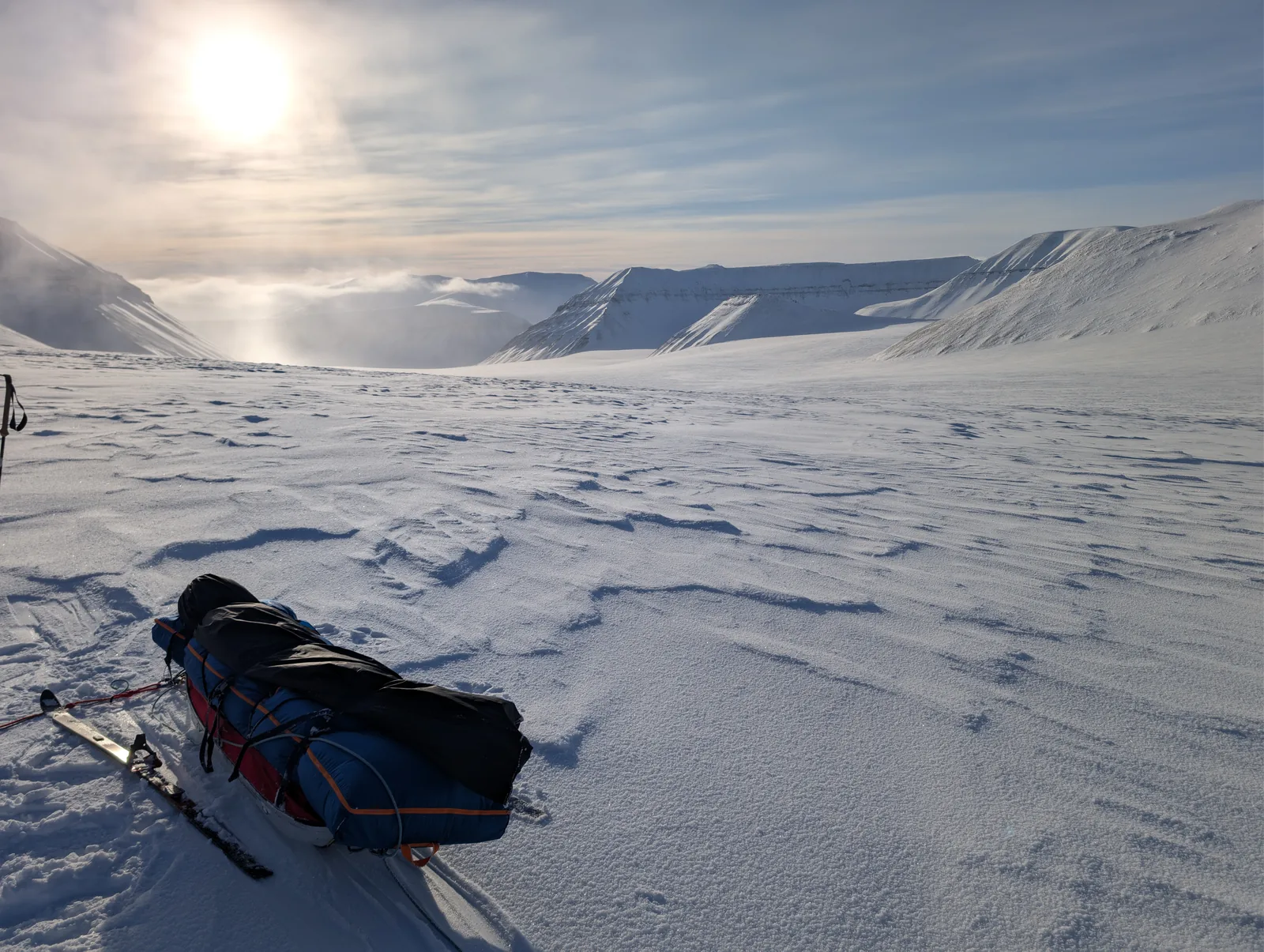
Day one was deliberately short. We worked up the wide valley on its southern side, which is where you want to be, because out of the wind and in the sun is a different climate from twenty meters away. We cut into a thinner side valley and dropped back down. We camped before turning south toward the first pass.
I was hopeless that first night. Not physically, organizationally. I did not know where anything of mine lived, and I had no routine for the thing that turns out to structure every evening, which is your feet. Boots off, feet dried, camp booties on, shell off, puffer layers on before you cool down. All of it in sequence, in a small space, with two other people doing the same thing.
The tent
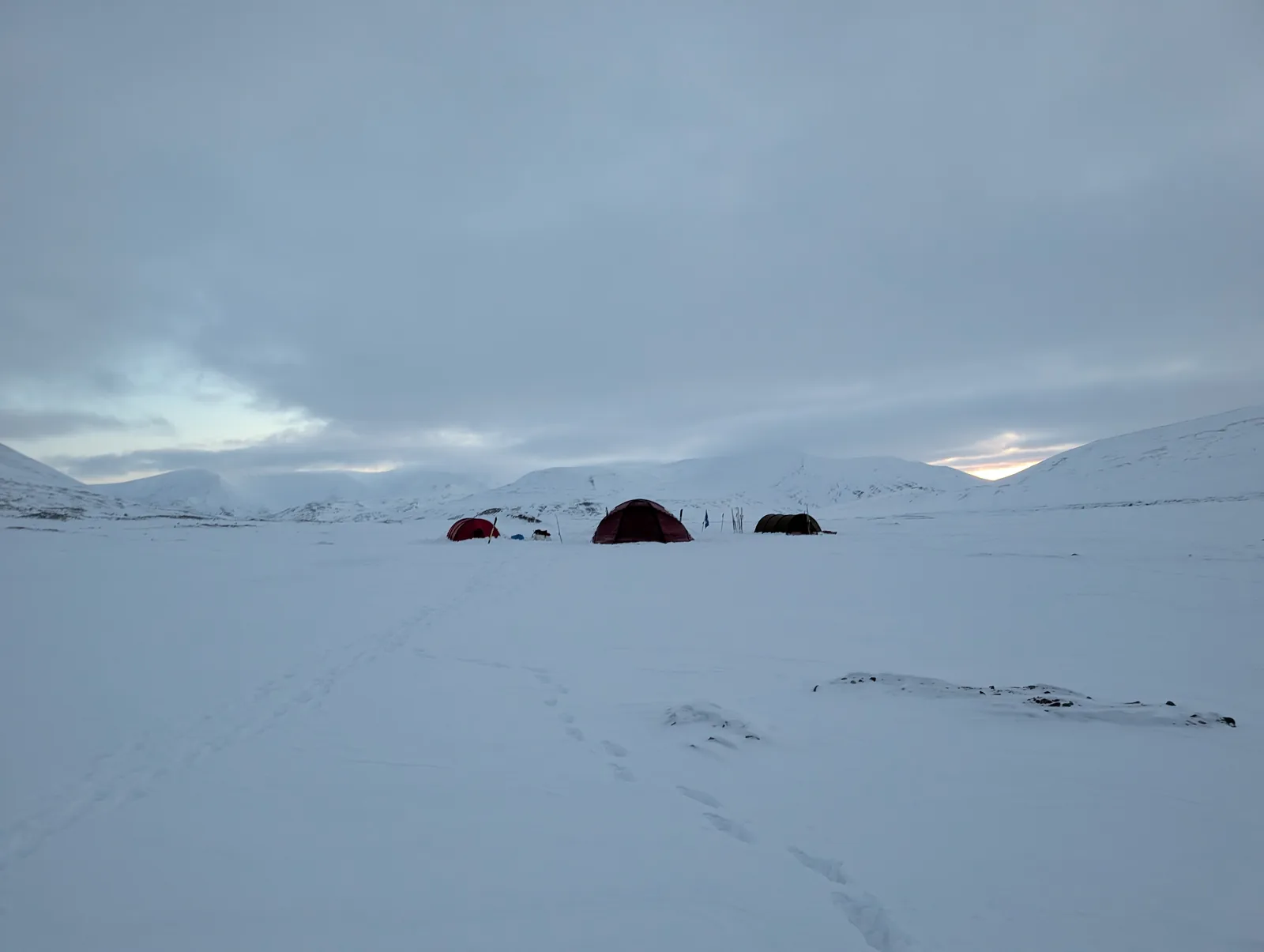
We were three to a tent, and the tent was excellent. Pitching it went the same way every night.
First you pick a spot and stamp it flat, skis still on, walking the outline until the snow is packed. Then you unroll the tent with one person always holding it, because a loose tent in wind is a kite with your bed inside it.
The poles never came out. When we struck camp in the morning we slid them out of their sleeves only far enough to break them at the middle, folded the halves back along the fabric, and rolled the whole thing into a large burrito. At the far end of the day you unroll the burrito and every pole is already lying where it needs to be. Push, spring, done.
Pegs went in at forty-five degrees and then got a boot heel driven down on them. Snow packs around them and sets, and by morning some are genuinely hard to retrieve. They were aluminum and light, and you could bend one if you were careless.
The back of the tent goes into the wind and the front door sits downwind, so the air runs the length of the tunnel rather than across it. You never want wind on the flank. We set the upwind end first, walked to the other, pulled it taut, and built out from the middle. An extra five minutes getting it straight and tight bought a much better evening, and Andrew, Keith, and I were fussy about it.
In the vestibule we dug a footwell about two feet deep, so you could sit on a ledge with your feet down in the hole rather than folded under you. On the other side of the door we cut a seat for whoever was cooking. Then we buried the bottom six inches of the tent skirt all the way around, and on windy nights built a snow wall about five feet upwind, so the air broke around us instead of turning the tent into a drum skin.
Water is the tax on everything
You are surrounded by water and none of it is liquid. That is the whole problem, and it eats your evening.
I was going through six to seven liters a day, and that counts the water that went into rehydrating the food, which was a lot. I carried a 48 ounce Nalgene, a 32 ounce Nalgene, and a 1.5 liter thermos. Most of the melting happened at camp in the evening, and we would get a kettle running again first thing in the morning to fill the thermoses hot, so the water was still drinkable hours into the day instead of freezing in the bottle. It felt like there was always a stove running.
Our snow hopper was a blue IKEA bag. You fill it, and somebody works through melting it down. That was one person's entire job on arrival, and the thermoses went into the tent before anything else did. Two people build, one melts, and when the first bed is made you swap so the melter can sort their own kit.
The physics is against you. Warming snow from twenty below to freezing, melting it, and heating the result to ninety degrees costs about 752 kilojoules a liter, and 44 percent of that goes into the melt alone. Turning the solid into a liquid costs more than heating the liquid afterward. Snow is also mostly air, so you are shoveling something like 22 liters of snow to end up with six and a half liters of water. For a tent of three across five nights, that is about 98 liters of water and over twenty kilowatt hours of melting.
So the stove went on as early as we could get it going. Tent mostly up, footwell dug, stove lit, kettle filling. You would drop in a big chunk of snow and it was like watching an iceberg melt, it would just disappear.
I carry an MSR XGK EX, the brute of the range, and it sounds like a small jet engine. The guides carried WhisperLites and preferred them because they are quieter, and theirs were the stoves we cooked on all week. I had optimized for capability. They had optimized for the two hours a night somebody spends sitting next to the thing in a confined space, where holding a conversation matters more than raw output.
Food, and the arithmetic of losing
Dinner was a freeze-dried meal rehydrated with the water we had just made, somewhere between 600 and 900 calories, plus a soup with ramen noodles broken into it. Breakfast was freeze-dried eggs, or oats with powdered milk, nuts, raisins, and chunks of chocolate, which was better than it has any right to be, with coffee.
On the move it was my own trail mix. Dried dates, peanut butter pretzels, cashew honey clusters, M&Ms, and granola, portioned into bags of 250 to 300 calories each, six a day, plus two or three Kind or RX bars.
Add it up and I was eating somewhere between 3,500 and 3,800 calories a day. The Whoop says I burned 5,596 on average across the five full days and 5,969 on the biggest. My normal figure in the seven weeks beforehand was 2,444, so I was running at more than twice my usual output, every day.
That leaves a deficit of two thousand-odd calories a day, about three pounds of body fat across the trip. There is no way to close it. You do not carry that food and you would not want to eat it if you did. You just come off the ice a little slimmer than you went on. Stretched across a fifty-day expedition, the same deficit is nearly thirty pounds, which is why the long trips take their food planning so seriously.
The thing I wish I had packed was Cadbury's Dairy Milk, and really not just one bar, a few bars.
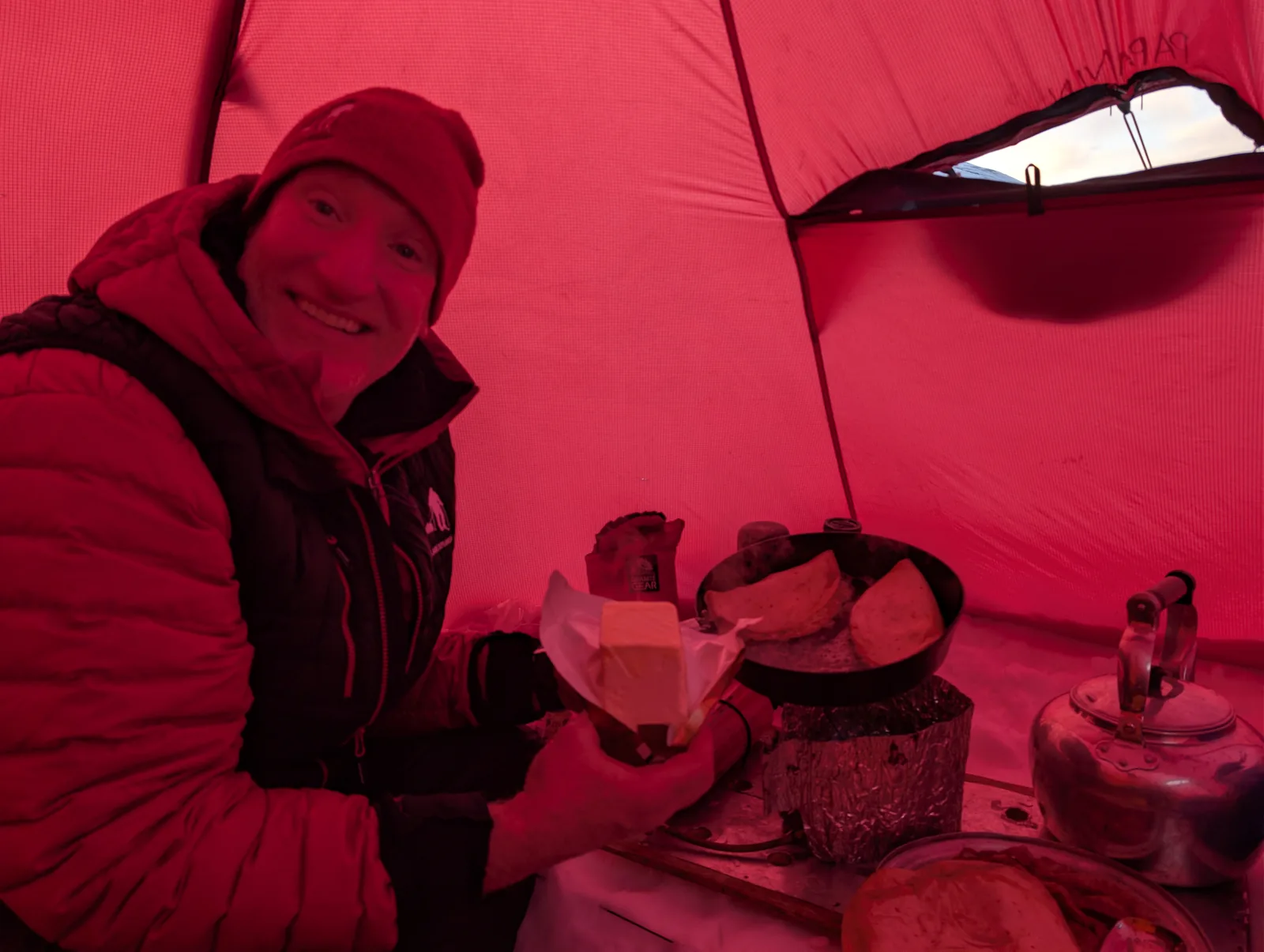
What Keith and Chris did instead was carry cheese, pre-cooked bacon, tortillas, and a block of butter over a mountain pass, and make quesadillas on two separate nights. That far into a deficit, that is not a snack. It broke up the monotony and the difficulty of the trip for the whole group, and little touches like that were things the two of them just knew to do.
Organize by time of day, not by body part
My instinct at home had been to pack in categories. Upper body in one stuff sack, lower body in another, socks and gloves together, food together. It is tidy and it is wrong. On the ice you never reach for a category. You reach for whatever the next half hour needs.
So I switched to three bags by time of day. A morning bag with a wipe, breakfast, fresh socks, toothbrush, and instant coffee. A day bag with the glove layers and the faceGlove for my nose. An evening bag with dinner, bowl, and cutlery, ready to grab. I built all three in the tent the night before, and the next morning I could get out and moving without unpacking anything.
The constraint out there is minutes spent with the tent open, and minutes spent standing in the cold with your gloves off looking for something small.
The pass
On the morning of day three we roped up and climbed the glacier toward the first pass in total fog. The last stretch was switchback after switchback, and the whole way up we could not see the top of the mountain we were on.
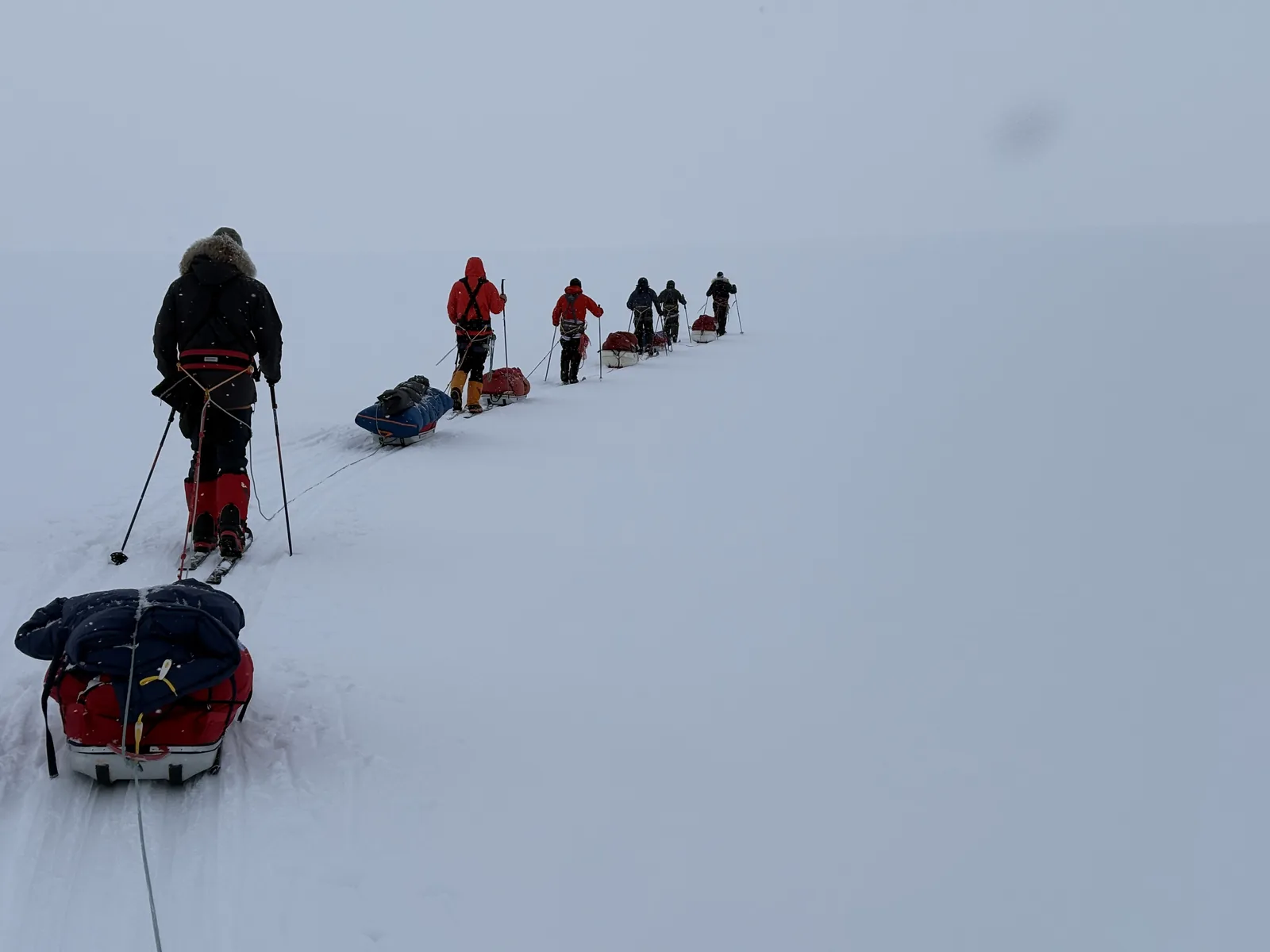
Then we came through the pass and the cloud broke and the sun came out, and it was the most extraordinary place I have ever stood. Everyone got their cameras out. Then we dropped a little way down the glacier on the far side and made camp on the ice.
Camping on a glacier is a different job. You go around the site with an avalanche probe first, working out where the crevasses are and are not, then you mark the boundary of the safe ground with your skis stood upright. The area you end up with is small, noticeably smaller than an off-glacier camp, and moving around inside it takes more thought.
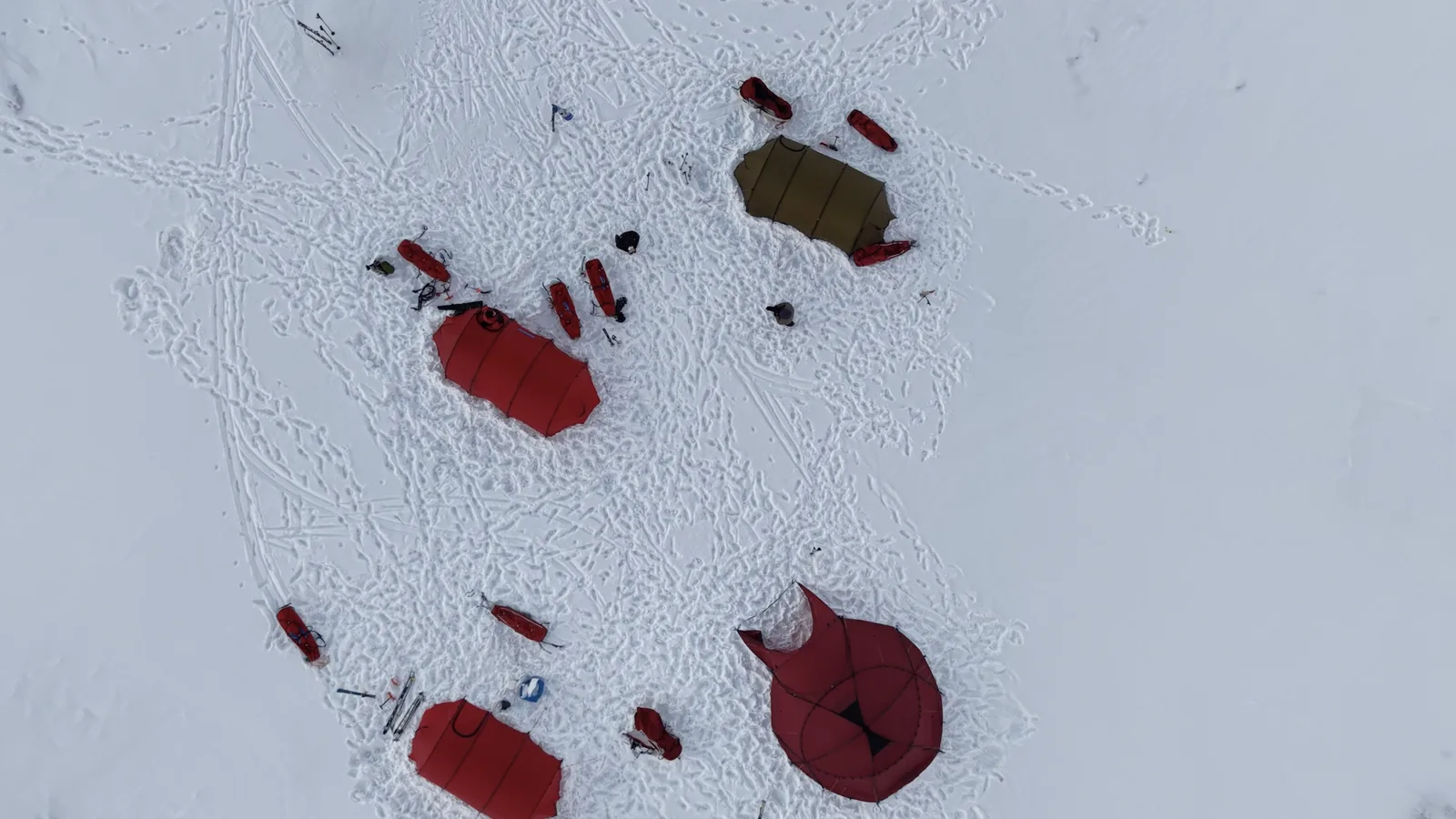
I took the drone up for forty minutes that evening, over the tents, over the glacier, in the best light I have ever flown in.
I did not press record.
The shape of a day
Most days formed around a very similar routine, awake around six or seven. Water on for breakfast. Everyone breaking down their own kit and loading their own sled, and me building the three bags for the day ahead. Tent last onto the sled, because it is the first thing you need at the other end. Moving by nine or half past.
Then fifty minutes of skiing and ten minutes of stopping, over and over. Six to eight of those a day depending on how the group was going. Uphills were punishing, and we would generally try to finish a climb rather than camp partway up one. Downhills were their own problem, because you have to walk the sled off to one side and keep it from overtaking you. On the steeper ones I never really acquired the technique, so I sat on my pulk and rode it down like a toboggan, which worked.
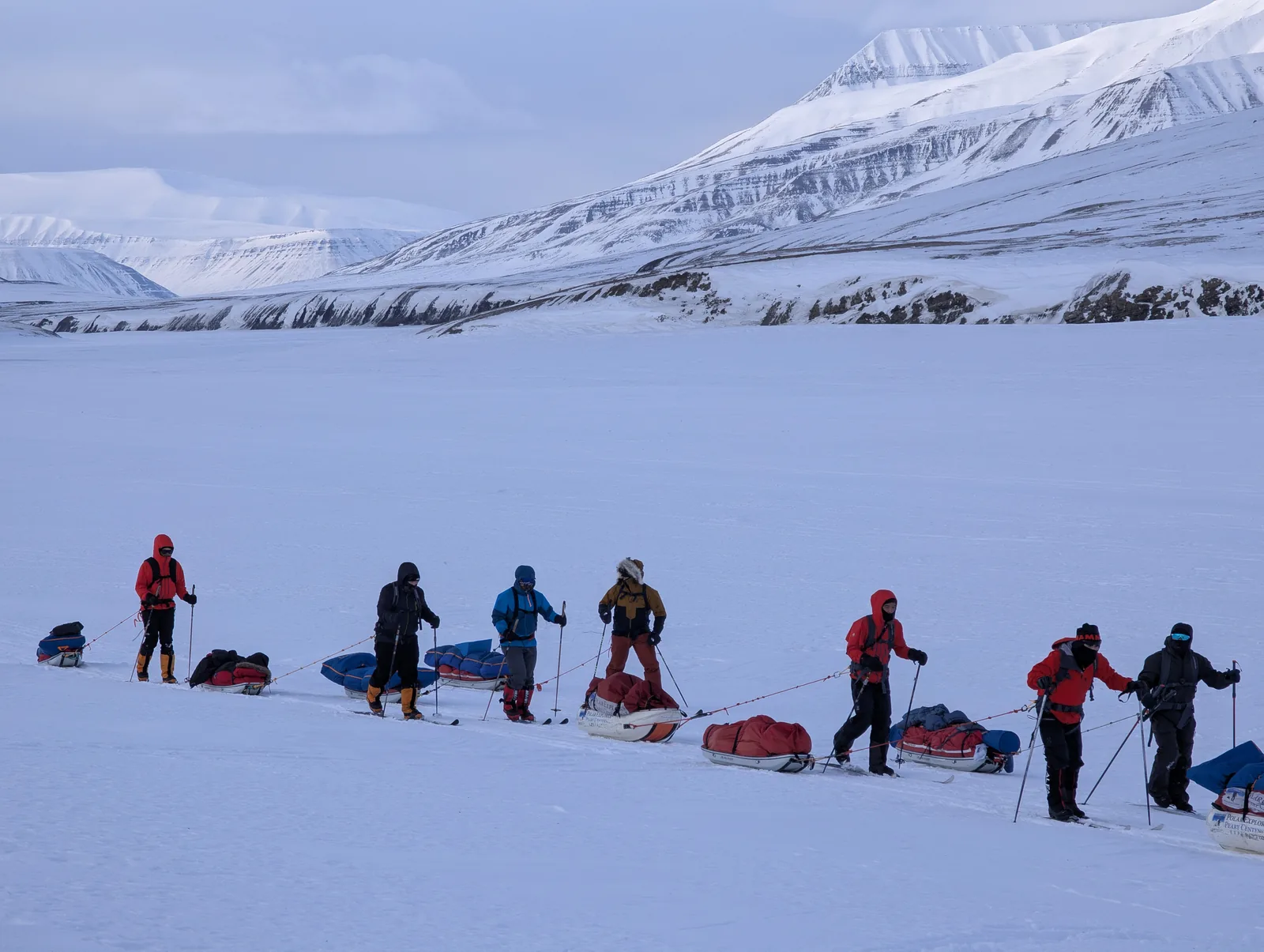
Camp between four and five. Thirty to forty minutes to set up. An hour or two eating. Then bed, because you are finished. Asleep by nine or ten, awake at seven.
The Whoop puts numbers on that. Across six days I recorded 31 hours of actual movement, which is 5.2 hours a day inside a waking day of fourteen or fifteen.
So the skiing is the smaller half of the job. The rest is camp craft, snow melting, foot management, packing, and eating. All my training prepared me well for the five hours and not at all for the other ten, and that is exactly why this trip exists. You cannot practice the domestic half on a rowing machine in Kansas City, and it turns out to be most of it.
Be bold, start out cold
You are working hard in cold air, and the easy mistake is dressing for the temperature instead of for the effort. Sweat is the enemy, because it is wet and then it is frozen.
The sequence I settled into went like this. Breaking camp I would be in my 800 down parka, because I am moving slowly and doing fiddly things with my hands. Underneath, a thin base layer, merino, and possibly my TNF ThermoBall. The moment we started skiing, the parka came off and went in the bag, and within about ten minutes so did the ThermoBall, swapped for the L5 hard shell. A shell blocks wind and keeps your own heat near you without adding insulation, which is the difference between staying warm and cooking. By the time I was properly moving I was cold, and that was correct.
In the ten-minute breaks you reverse it fast, because you stop producing heat immediately and the wind does not stop. My legs run warm, so shells and light merino were enough down there. On top I would put the down parka straight back on, or sometimes the Nuptse vest instead, depending on whether I would be standing in sun with no wind or shade with wind. That choice mattered more than I would have guessed.
Hands were where I dumped the most heat. I skied in thin liner gloves most of the time, deliberately, and put heavy mitts on at every stop. That worked for five days.
On day five I was slack breaking camp and let it go too far. I felt the sensitivity go out of my fingertips, the numbness and then the dead feeling at the ends, which is the front edge of frostnip. I got a hand warmer in and it made an enormous difference, but I kept the mitts on much longer than usual afterward because the blood took its time coming back. That was the one real mistake I made all week, and it happened because I was doing something else and not paying attention to my hands.
Bear watch
There was a communal tent, and somebody was awake in it all night.
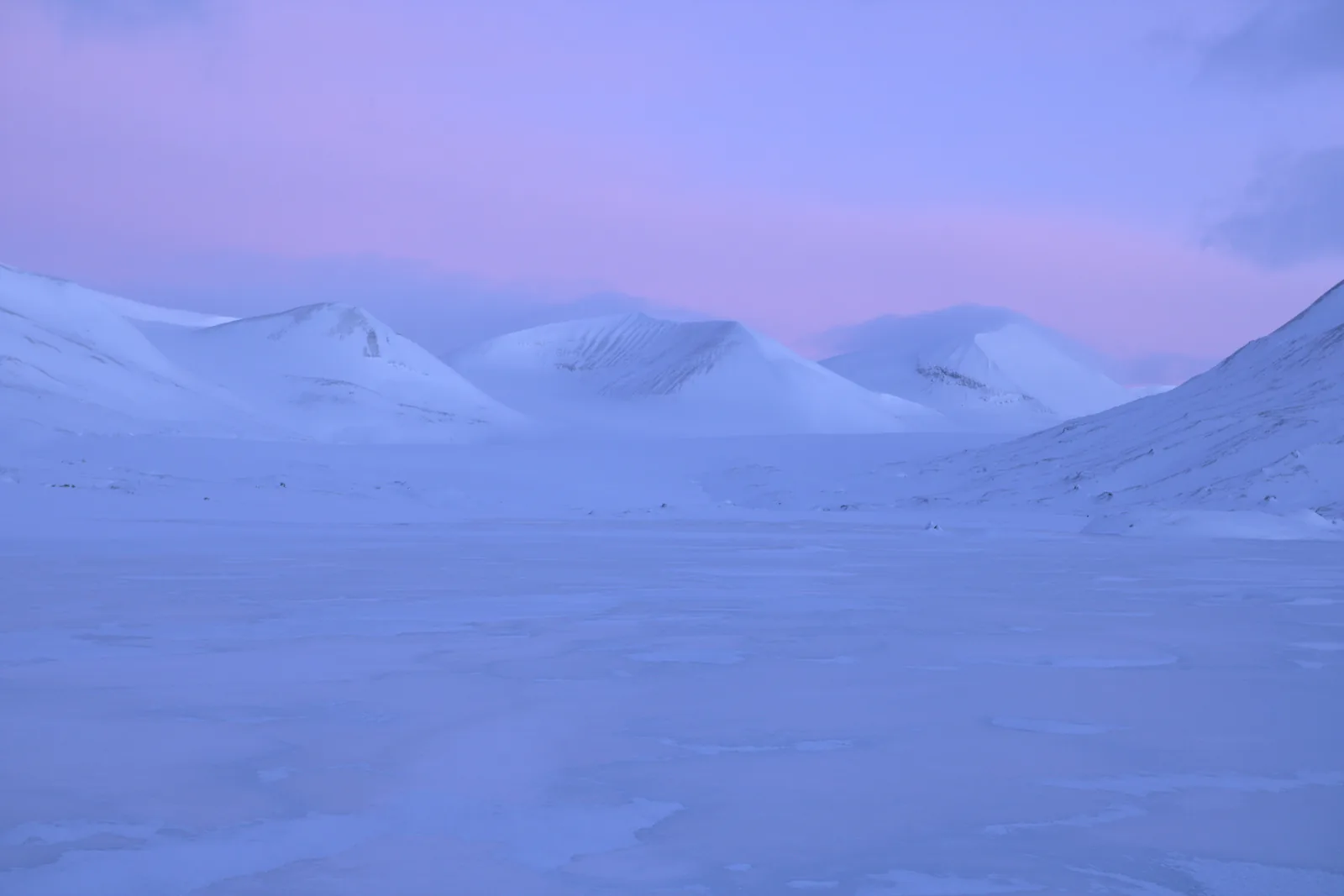
We ran two-hour shifts from ten at night until six in the morning, four people a night. With nine of us, most stood two watches across the trip and two of the group stood three. It never got properly dark, because it was the end of March at 78 north. Dusky, then dusky again, never black. Sitting out at two in the morning in that light, looking at something majestic and wild and perfectly capable of killing you, is a strange and good way to spend two hours.
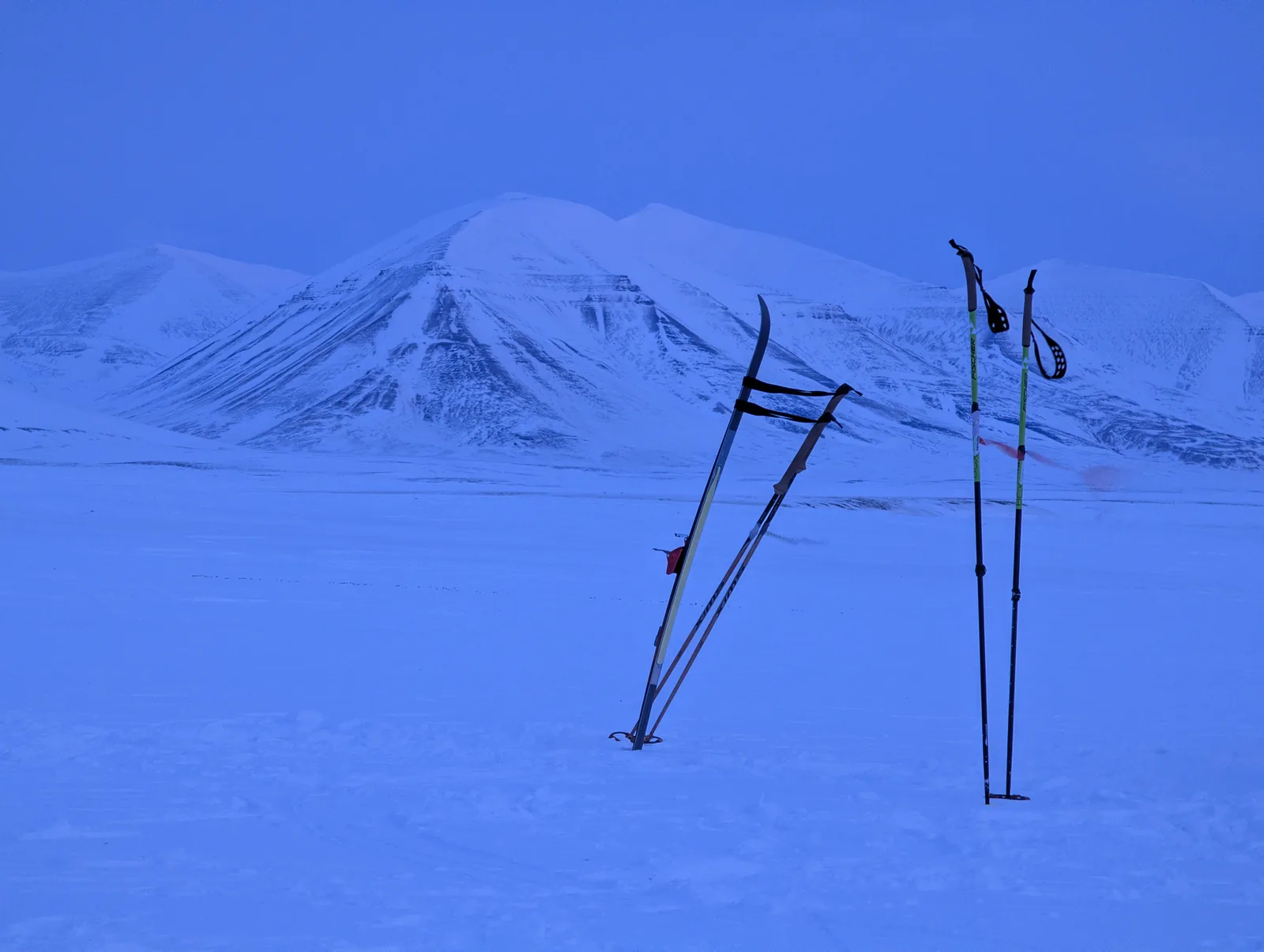
On my first watch a bird landed just outside the tent. All I heard was a rustle in the snow, and I was out of that tent faster than I have ever moved in my life. It was about ten feet away and it was very small.
We never saw a bear. Not once, in six days. That is what the discipline actually is. Hours of watching, a rota, and nothing arrives. The guides kept the rifle, because one of them was accountable for it, and left the flare gun with whoever was on watch. The procedure if you saw something was to wake a guide first and then act.
Again the Whoop caught the cost of it. On the night of the 3rd of April I fell asleep at ten to ten, woke at ten to two, went back down at ten past four, and got up at five to seven. Whoop scored the second block as a nap because it did not know what else to do with it. That is a two-hour watch, in the middle of the night, written into my sleep data.
The stranger finding is that I slept better on the ice than at home. Eight hours a night on average against a normal seven and a half, with efficiency between 89 and 95 percent. One night I got nine hours.
Going to the bathroom
You cannot walk far, because you should not get away from the flare gun and the rifle. So you are managing modesty and safety at the same time, with people you met four days ago.
For a pee, easy enough, particularly as a man, and there were no women on our trip. For anything else it took more organizing. I would go a bit further out, build myself a foot or two of snow wall, and dig a hole to squat over, three or four feet down. We ran leave no trace, so paper and anything like it does not get buried. It goes into a bag, the bag goes into the bottom of the sled, and the cold keeps it frozen until you are back in town. I would take a kitchen towel over toilet paper every time, because with a mitt on at twenty below you want something you can handle quickly and once.
The pee bottle defeated me at night. Getting yourself oriented inside a sleeping bag, in a three-man tent, so you can kneel and use a bottle without incident is harder than it sounds, and I never got it under control. On the Greenland crossing they put two people in a four-man tent, and after five nights of this I understand why. Over five nights an improvisation is an inconvenience. Over thirty it has to be a system.
On day five I happened to notice Keith going about the same business, and he had cut himself footholds so he could get lower to the ice. It had not occurred to me and nobody had said it. Six days is not long enough to be taught everything, and some of what you need only transfers by watching somebody who has done it four hundred times. Just don't watch too closely.
The other things that happened
On day four we crossed a crevasse coming off the glacier. Chris was out ahead leading, found it, and we came over roped up in two teams. I was at the front of my rope, so I was one of the first across.
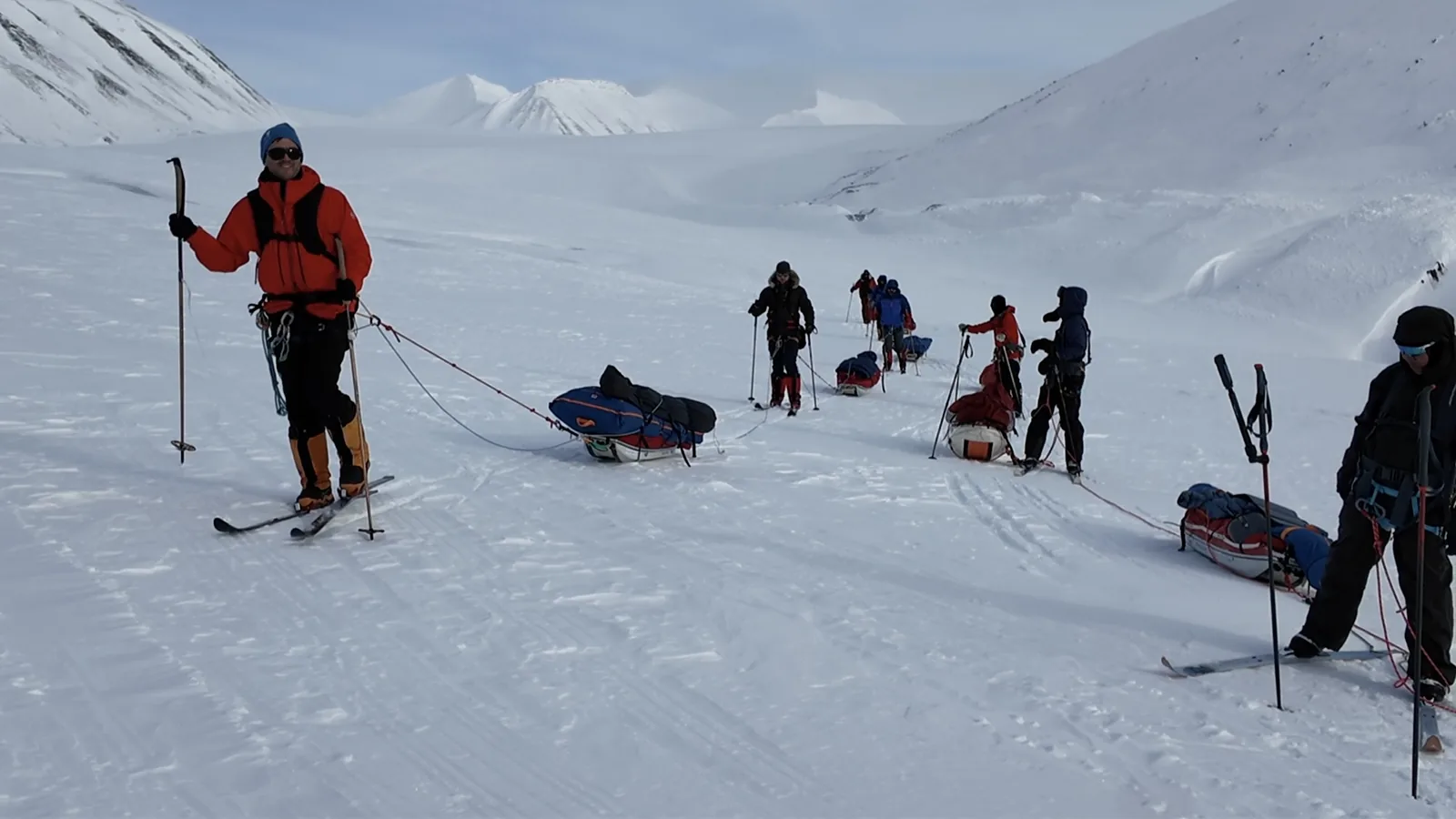
On day five we were comprehensively overtaken. Five or six Norwegian women, out on an Easter trip because they live there, the winters are long, and Easter is when the light comes back and everyone gets a long weekend. They were doing a similar loop to ours at significantly greater speed, and they laid waste to us.
If the weight in your pulk was not balanced right and you were tracking along the side of a valley with any camber to it, the pulk rolled over. Then it rolled over again. Each time you stop, walk back, flip it the right way up, and get moving again. It was enormously frustrating, and keeping the sled upright turned out to be one more thing you learn to manage.
Very little actually broke. My faceGlove vanished for three days and I was certain I had left it at a campsite, because it is small and it is exactly the sort of thing you lose. I searched every pocket several times. It was in a pocket. One of my freeze-dried meals had gone bad. It smelled slightly wrong when I opened it, the first mouthful settled the question, and it went in the trash.
The only real "emergency" was a punctured inflatable mattress belonging to one of my tent mates, which out there can turn serious quite quickly. The fix is heat, applied to everything. We warmed water bottles and held them against the mat, the patch, and the surface we were working on, because adhesives barely work in the cold. Found and sealed inside thirty minutes, holding air within the hour.
One thing I was not warned about was the mornings. You breathe out moisture all night, it freezes on the inside face of the tent, and when the fabric starts moving in the morning it comes down on you, a light snowfall of everybody's breath. It is disgusting when you think about what the internal snow shower is made of.
Snow is not one thing
Something I only understood by pulling a sled across it. Dry snow glides and is the best surface to haul on. Wet, sludgy snow grabs the sled and makes the same weight feel heavier. Then there is ice, on frozen riverbeds, where the sled goes wherever it likes and I felt least stable of anywhere on the trip.
Day six
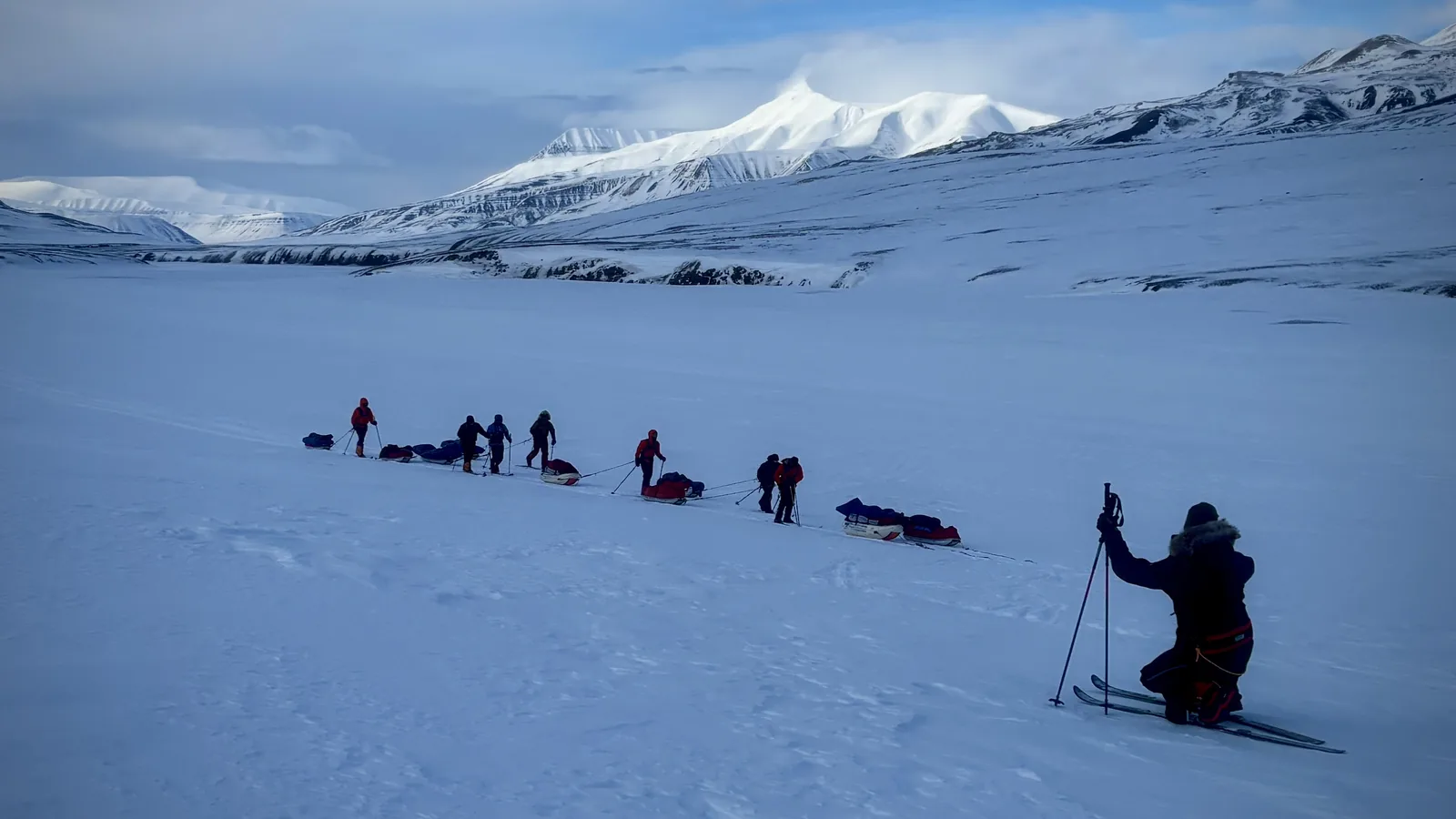
The last day turned out to be a long half-day. Down the far side of the last pass, out along a valley braided with dog sled tracks, and back to Camp Barentz. My last recorded movement stops at nineteen minutes past one in the afternoon.
Then back to the hotel, the Radisson, where we'd left our travel bags, and into a shower.
We stayed at the Radisson Blu on the last night because we wanted to treat ourselves. It is comfortable, and it is expensive for what most Americans would recognize as a standard Hilton or Marriott room. Not a remarkable room. The breakfast, though, was outstanding, and after six days of a two thousand calorie daily deficit I sat in it for about three hours and ate my way through most of the cost of the room.
The nine of us
PolarExplorers assemble the group, so you turn up and find out who you are spending a week in a tent with.
There were nine of us. Me and Andrew. Keith and Chris guiding. Yuki, Sumi, and Yoshi over from Japan, who were absolutely hilarious from the first day to the last, and one of whom turns out to be a professional public speaker at home. Dan, an American long-distance cyclist. And Adam, from Poland.
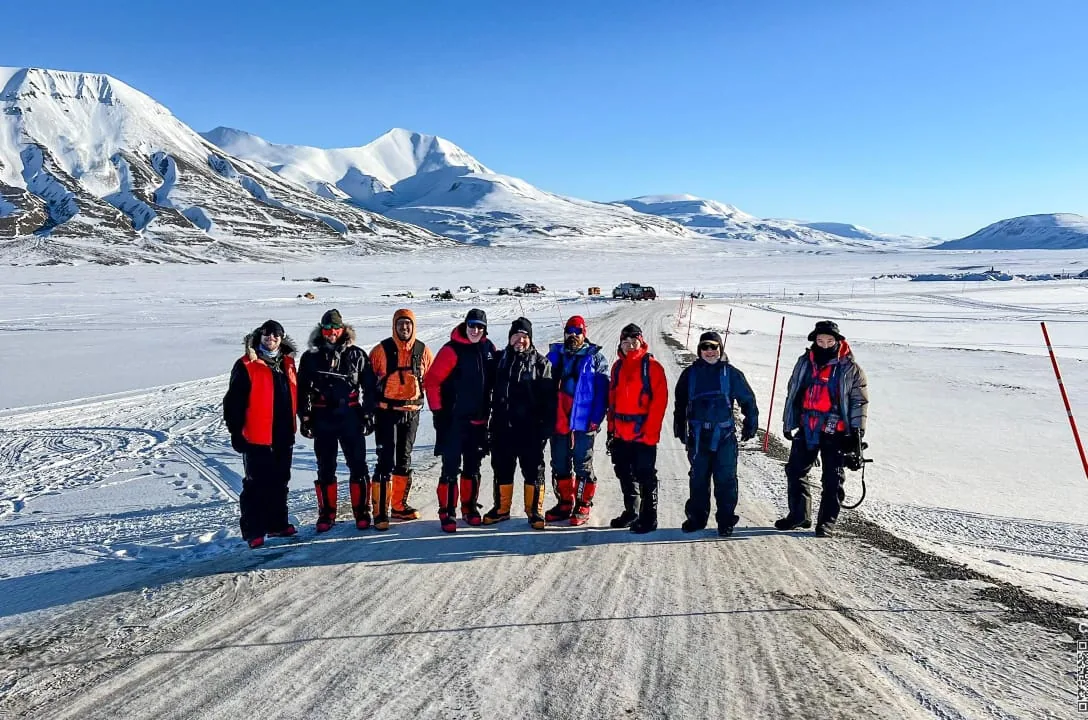
That composition is a large part of what you buy, and none of it is in the price list. Several of the people out there had no polar ambitions at all. Andrew certainly did not. They had come because six days on the ice above Longyearbyen is a good thing to do on its own terms, which it is.
The group also sets your pace, so your day is partly a function of the eight other people. Ours was not perfectly matched. One of our team was slow, and at times that was painful, for them as much as for the rest of us I am sure. If I were structuring these groups I would think about building them around a cardiovascular baseline, so that people with similar engines end up on the same ice together.
What they told me at the end
PolarExplorers finished with a proper debrief. There was a certificate and a handshake, and there was also an assessment of where each of us was and what to work on.
Mine was mostly ski technique. They thought an extended trip would help me get ready for a South Pole from the coast. And they said that if I only wanted to do the last degree, I was probably ready now.
Six days of training, and by their reckoning I was already there for the version most people treat as the big achievement.
That settled something I had been chewing on all week. The last degree is 111 kilometers over ten or eleven days, and it costs $85k (ish). Our training loop was somewhere around seventy kilometers in six days, and I was a beginner learning the drills as I went. More than half the distance, at much the same daily rate. The last degree is a real expedition and I do not think it would tell me where my limits are, and finding my limits is the point. The coast is 1,130 kilometers at double the daily rate. That is the version I want, and Svalbard was about six percent of it.
What six days proved, and what it did not
What it proved is that I loved it. At the end of six days I wanted another six, and then another six after that. I would have stayed out there indefinitely, and I was disappointed to be finished.
That was the actual question, and I could not have answered it from a spreadsheet. Whether the cold, the discomfort, the tedium of melting snow for two hours a night, and the total absence of anything to do would turn out to be a thing I liked or a thing I had talked myself into. It is the first one, and now I know.
What it did not prove is almost everything else.
Five nights is not fifty. The skills were introduced, not embedded. I ran the pass, the crevasse crossing, and the camp routine once or twice each, which is enough to have done them and nowhere near enough to do them badly tired on day thirty-eight. I never found out what happens to my judgment when I have been cold for a month. I did about twelve kilometers a day at sea level, and a coastal Antarctic ski is about twenty-two a day at nearly three thousand meters on the plateau, in worse air and worse cold. And I was never alone with any of it, because there were guides making the decisions I would eventually have to make myself.
Greenland is the next step. About a month on the ice and somewhere around 550 to 600 kilometers, against the fifty-odd I did on Svalbard. Everything scales at once, which is the point. More weight at the start, more fatigue at the end, more of your reserves gone, and long enough that the improvisations either become systems or become problems. It costs around $21,500, which against the $150,000 or so that a coastal South Pole and Vinson would run to is a cheap way to find out something important.
There is a gatekeeping reason too. ALE, who fly everyone into the Antarctic interior, ask for a skiing or climbing resume before they will take you, and their questionnaire wants to know things like whether you can strip and service an MSR stove and navigate featureless ground on a compass. Svalbard plus Greenland is close to the standard answer for the ski. Vinson needs glaciated mountaineering on top, which is where New Zealand finally earns its keep.
The recovery data points the other way. My Whoop scores across the trip went 75, then 42, then 54, then 32, then 21, against a normal baseline of 66. I wanted another six days and my body did not. Both of those things are true, and I am not sure which one to listen to. Probably both.
Andrew is the other useful comparison. He was ready to be done by the end, and I wanted more. Neither of those is the right answer. It is just information, and it is the information the trip is for. If you come off six days relieved, you have learned something valuable and cheap. If you come off wanting more, you have also learned something, and it is going to cost you a great deal of money.
If you are thinking about doing this
Do the training trip before you commit to anything bigger. Six days and four and a half thousand dollars is a stupidly cheap way to find out something you cannot find out any other way.
If it is your first time on skis, your first time sleeping on snow, and you genuinely do not know whether you will enjoy it, five nights is right, and there is a decent chance you will love it. Andrew and I came in with completely different intentions and both got what we came for.
If you already know you like this and you are flying from North America, consider a bigger trip. The travel is the same either way, and Svalbard has far more ambitious expeditions leaving from the same town, up to and including full crossings of the archipelago. The Norwegian woman on my flight north was doing one of them.
Budget beyond the course price. The training is not the trip. Add flights, three nights in Longyearbyen, food at Longyearbyen prices, and whatever kit you do not already own.
Drone permissions took me an afternoon of admin plus a couple of emails. A rifle permit from the Governor of Svalbard is now running up to eight weeks, which several websites still get wrong, and I did not find out in time. I would have done it if I had.
And check the current rules rather than trusting a writeup, including this one. Svalbard's field safety regulations changed on January 1, 2026, and the requirements for travel outside the managed area moved with them.
What is next
Greenland in 2027. The icecap crossing, about a month on the ice.
Then, if the training holds and the medical holds and the money holds, Antarctica in 2028. From the coast, and Mount Vinson while I am down there. I will be in my early forties, and this is the kind of thing you do while you still have the health and the time.
I have written up every item of kit I own for this, what I paid, and why. The rest of the plan is on the Antarctica page.
I trained and traveled with PolarExplorers, March 29 to April 6, 2026. They were excellent and I have no arrangement with them.